How Chatbot Works Technically
_(1).jpg)
As we move into 2026, chatbots are changing the way businesses talk to people. They help companies reply faster, support customers anytime, and reduce the need for human effort. With the help of AI, chatbots are becoming smarter and more accurate in understanding user questions.
Today, chatbots are used in many industries like e-commerce, healthcare, and banking. They help automate daily tasks, answer common questions, and improve customer experience. Knowing how chatbots works technically helps businesses use them better and gain more value from this technology. In this blog, we explore how Chatbot Works.
What is a Chatbot?
A chatbot is a software program. It talks to people using text or speech. It tries to act like a human in a conversation. You might see them on websites, messaging apps, or voice assistants.
There are two main types:
|
Type |
How It Works |
|
Rule-Based Chatbots |
Follows pre-set rules to answer questions. |
|
AI-Powered Chatbots |
Uses AI and machine learning to understand and respond. |
Rule-based bots are simple and fast. AI-powered bots are more intelligent and flexible.
How Chatbot Works Technically
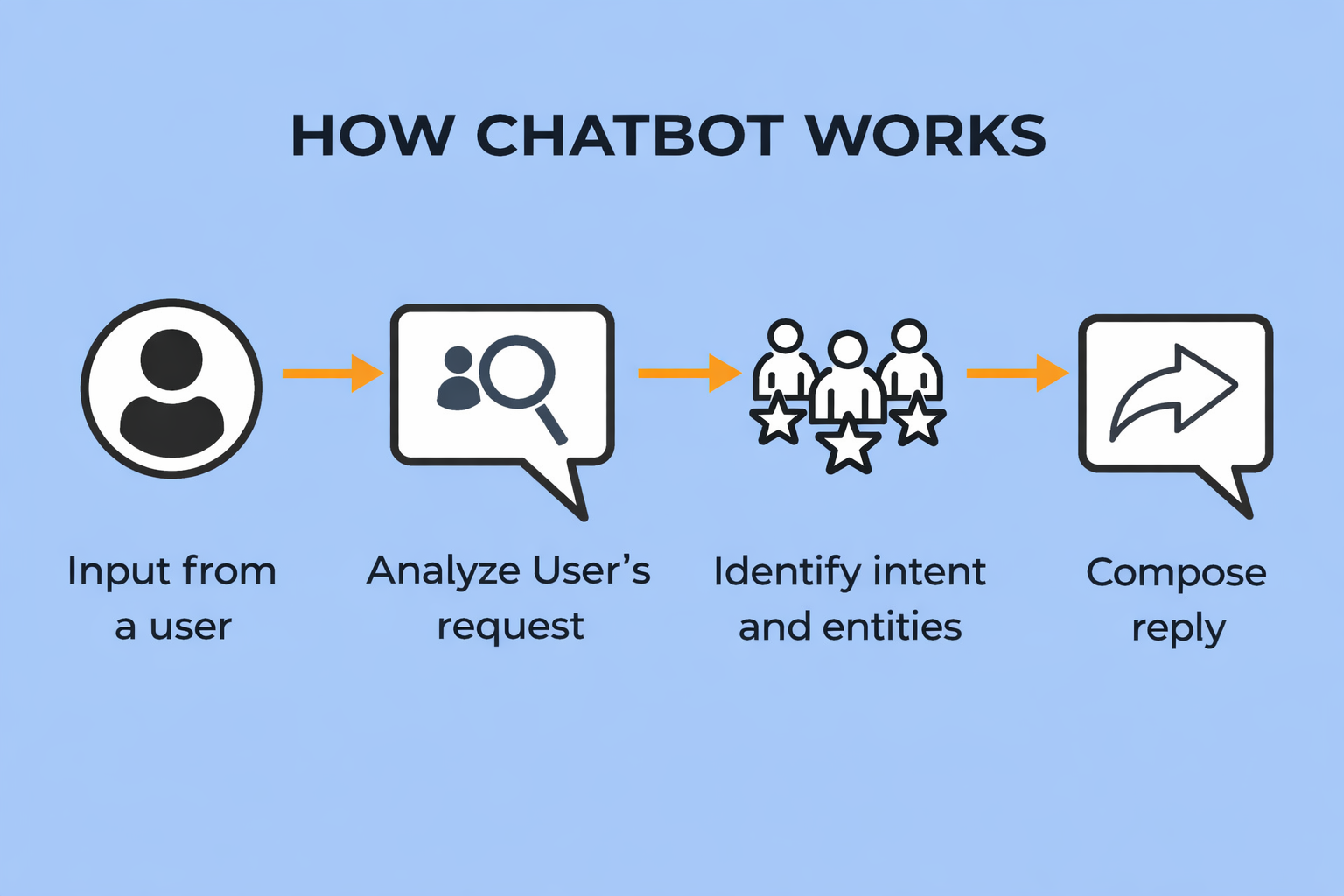
Chatbots are software systems designed to simulate human conversation. Behind the scenes, they combine Natural Language Processing (NLP), Machine Learning (ML), and AI models to understand and respond to users. Here’s how a chatbot works when you interact with it:
1. User Input
- The chatbot receives input from the user in the form of text or voice.
- If voice is used, it is first converted into text using speech-to-text technology.
2. The Bot Receives the Input
The bot takes your message and begins processing it. It may come through a website, app, or voice channel.
3. The Bot Understands the Message
This is the magic part.
- The bot uses Natural Language Processing (NLP) to understand your text.
- It figures out the intent (what you want).
- It finds entities (important details like dates, names, places).
4. The Bot Finds the Answer
Once it knows your intent, the bot looks for an answer:
- From a predefined answer list (rule-based).
- From a database or AI model (AI chatbot).
5. The Bot Sends a Response
The chatbot turns the answer into text or speech and sends it back to you. The whole process happens in seconds!
Technologies Behind Chatbots
Chatbots use several important technologies. Let’s break them down.
Natural Language Processing (NLP)
NLP helps the chatbot understand human language.
It does three main jobs:
- Break down sentences into tokens (small parts).
- Understand intent (what the user wants).
- Extract entities (important information).
Simply put, NLP makes computers understand human language like we do.
Natural Language Understanding (NLU)
NLU is part of NLP. It helps the bot figure out meaning.
It focuses on:
- Intent Recognition- What the user wants.
- Entity Extraction -Important details like dates or names.
- Context Understanding -Keeping track of the chat flow.
Example:
User says: “Book a flight to Mumbai tomorrow.”
- Intent - Book flight
- Entities - Mumbai, tomorrow
This helps the bot respond correctly.
Natural Language Generation (NLG)
After understanding the question, the bot must create a response. NLG helps it generate text that sounds natural to humans.
So instead of sending pre-written phrases, the bot can form its own sentences. This makes conversations feel smoother and more natural.
Machine Learning (ML)
ML helps AI chatbots learn from past conversations. Most AI bots get better over time because they:
- Learn patterns from real interactions.
- Improve response accuracy.
- Personalize replies based on user behavior.
This is why chatbots improve over time.
Different Types of Chatbot Logic
Chatbots work differently based on how they are built:
1. Rule-Based Chatbots
- Follow simple if/then logic
- Best for basic questions
- Very fast but limited understanding
Example:
If user says “hi”, bot replies “Hello!”
2. Keyword-Based Chatbots
These bots look for keywords in your message.
Example:
- If you say “flight to Delhi.”
- They find “flight” and “Delhi” and answer accordingly
3. AI-Powered Chatbots
These bots use machine learning and NLP.
They:
- Understand context
- Learn from history
- Generate new replies
This makes them most flexible and natural.
Why Chatbots Work So Fast
A chatbot can:
- Process input instantly
- Analyze language in milliseconds
- Generate replies using trained models
This makes them useful for 24/7 support, quick replies, and handling many users at once.
Conclusion
Chatbots Work by combining several technologies that allow them to understand, process, and respond to human language quickly. From receiving user input to analyzing intent using natural language processing, every step happens in a structured technical flow. Rule-based chatbots follow fixed logic, while AI-powered chatbots use machine learning to improve over time.
Behind the scenes, components like NLP, dialog management, and response generation work together to deliver smooth conversations. This technical setup is what makes chatbots fast, reliable, and useful across industries, helping businesses communicate better and provide instant support to users.
FAQ
- Rule-based chatbots -respond using fixed rules and keywords
- AI-powered chatbots -use machine learning and natural language processing
- Hybrid chatbots -combine rules with AI capabilities
Voice chatbots -interact with users through voice commands
-

Krishna Handge
WOWinfotechJan 09,2026