How to Train an AI Model: Guide 2026
_(1).jpg)
Are you curious about how to train an AI Model and use it in real-world applications? Artificial Intelligence is no longer complex or limited to researchers it is a practical technology used in healthcare, finance, marketing, education, and business software.
In 2026, learning how to train an AI model is an important skill for building smart, reliable, and scalable solutions. In this guide, we explain how to train an AI model step by step using simple language, modern practices, and responsible AI principles to help you understand.
What is AI Model Training?
AI model training means teaching a computer system by giving it lots of data. The system learns from this data to find patterns, make decisions, and perform tasks. It improves over time by learning from mistakes, similar to how a child learns through examples.
This repeated process of learning and improvement helps AI models make accurate predictions even when they see new data.
Entities and Concepts
- Artificial Intelligence (AI)
- Machine Learning (ML)
- Deep Learning
- Neural Networks
- Supervised Learning
- Unsupervised Learning
- Reinforcement Learning
- Large Language Models (LLMs)
- Foundation Models
During training, an algorithm adjusts internal parameters (weights) to minimize error using historical or simulated data.
Step-by-Step Guide: How to Train an AI Model
Below is a step-by-step guide explaining how to train an AI model, from data preparation to deployment and improvement.
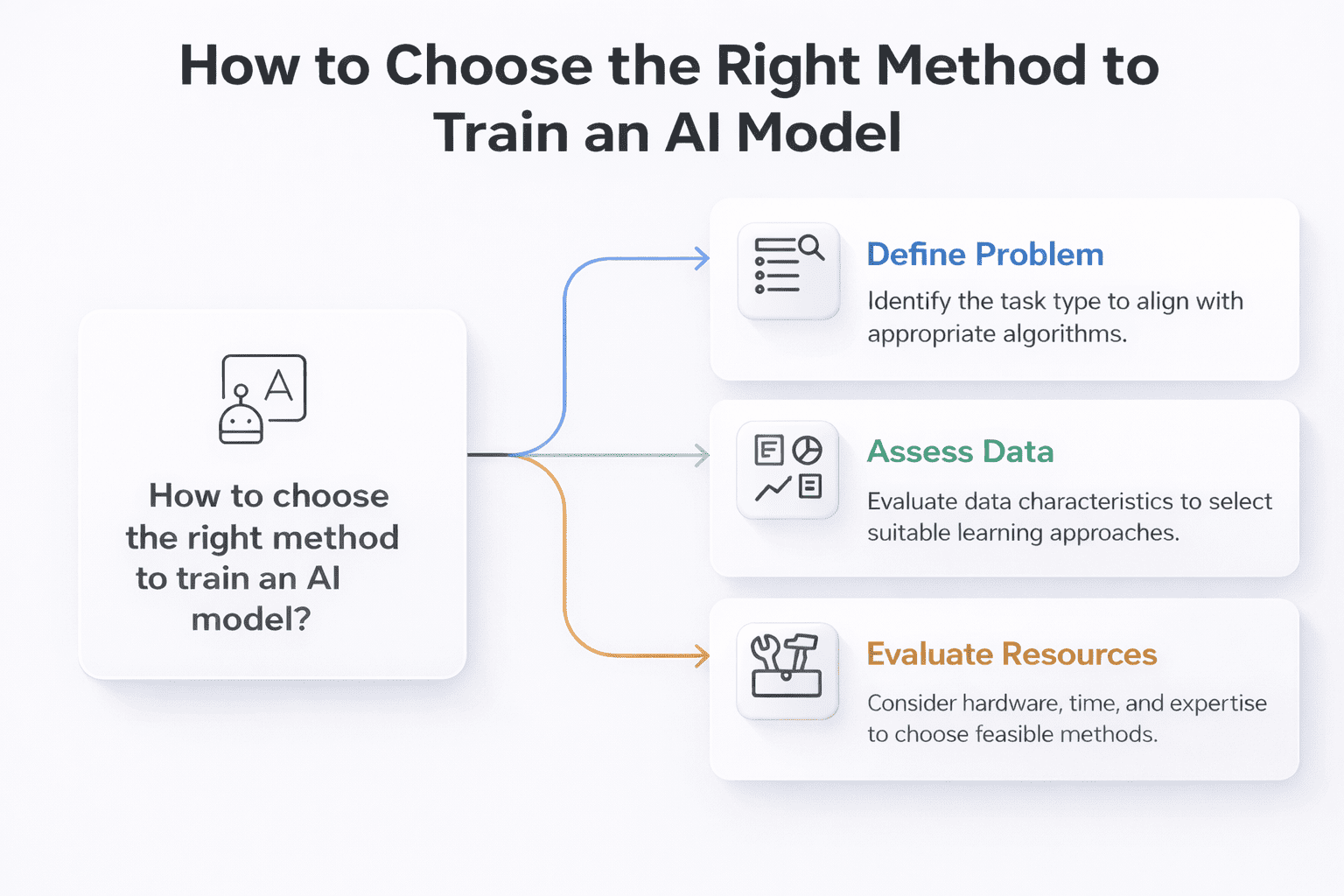
Define the Problem and Objective
Every AI project starts with a clear question. We first understand your business challenges, goals, and expected outcomes. This helps us design an AI solution that delivers real value and clear results.
Ask:
- What problem am I solving?
- Is this classification, regression, prediction, or generation?
- What business or user outcome matters most?
Example objectives
- Predict customer churn
- Detect fraudulent transactions
- Generate human-like text
- Classify medical images
A clearly defined objective determines the dataset, algorithm, evaluation metrics, and deployment strategy.
Choose the Right Learning Approach
Select the learning method based on your problem. We analyze your data, goals, and use case to choose the most effective approach. This ensures better accuracy, performance, and results.
- Supervised Learning: Labeled data (e.g., spam detection)
- Unsupervised Learning: Pattern discovery without labels
- Reinforcement Learning: Learning through rewards and penalties
- Self-Supervised Learning: Common in modern language and vision models
In 2026, self-supervised and transfer learning dominate large-scale AI systems.
Collect High-Quality Data
The quality of data directly affects how well an AI model performs. We gather, clean, and organize accurate data to ensure reliable and effective results.
Common Data Sources
- Internal company databases
- APIs and event logs
- Sensors and IoT devices
- Public datasets (Kaggle, Hugging Face, Google Dataset Search)
Best Practices
- Ensure data relevance and diversity
- Avoid over-representation of any group
- Follow privacy and data protection laws (GDPR, CCPA, EU AI Act)
- Document data sources for transparency
High-quality, well-governed data matters more than sheer volume.
Prepare and Preprocess the Data
Raw data needs to be cleaned and organized before it can be used. We process the data into a format the AI model can easily understand and learn from.
Data Preparation Steps
- Remove duplicates and corrupted records
- Handle missing values
- Normalize and scale numerical features
- Encode categorical variables
- Tokenize text (for NLP models)
- Augment images (for computer vision)
Well-prepared data improves learning efficiency, accuracy, and fairness.
Select the Model and Architecture
The right model is chosen based on your task, data size, and available resources. We select an efficient structure that delivers accurate results without unnecessary complexity.
Common Model Choices
- Linear and Logistic Regression
- Decision Trees and Random Forests
- Gradient Boosting (XGBoost, LightGBM)
- Convolutional Neural Networks (CNNs)
- Transformer-based models (BERT, GPT-style models)
In 2026, most teams fine-tune pre-trained foundation models rather than training from scratch, saving time and cost.
Train the AI Model
Training means feeding the prepared data into the model and adjusting it to improve performance. We fine-tune the model so it learns patterns accurately and delivers reliable results.
Core Training Components
- Loss function
- Optimizer (Adam, SGD)
- Learning rate
- Batch size
- Number of epochs
Popular Training Frameworks
- PyTorch
- TensorFlow
- JAX
- Keras
Training may occur locally, on cloud GPUs, or across distributed clusters.
Evaluate and Validate Performance
Training accuracy alone isn’t enough to judge success. We test the AI model on new data to ensure it performs well in real-world scenarios and meets your business goals.
Common Evaluation Metrics
- Accuracy
- Precision, Recall, F1-Score
- Mean Absolute Error (MAE)
- ROC-AUC
- BLEU and ROUGE (NLP)
Validation Methods
- Train-test split
- Cross-validation
- Bias and fairness testing
Evaluation ensures the model generalizes well and performs reliably in real-world scenarios.
Deploy the Model
Deployment puts the trained AI model into action so it can be used in real-world applications. We ensure it runs smoothly, integrates with your systems, and delivers results reliably.
Deployment Options
- Cloud platforms (AWS, Azure, Google Cloud)
- APIs and microservices
- Edge devices
- Containerized environments
MLOps Tools
- MLflow
- Kubeflow
- Docker
- Kubernetes
- CI/CD pipelines for ML
Modern AI systems rely on automated deployment and version control.
Monitor, Maintain, and Retrain
AI models can lose accuracy over time due to changes in data or trends. We continuously monitor performance, update the model, and retrain it to keep results accurate and reliable.
Post-deployment tasks include:
- Monitoring performance metrics
- Detecting bias or anomalies
- Updating datasets
- Retraining and redeploying models
AI training is a continuous lifecycle, not a one-time event.
Conclusion: How to Train an AI Model
Training AI models in 2026 is changing how businesses use smart technology. It helps improve decisions, automate tasks, and make operations more efficient.
AI can personalize services, predict trends, and provide reliable solutions that grow with your business.
By 2030, AI will become even smarter, self-learning, and easy to integrate, helping businesses work faster, make better decisions, and serve customers more effectively.
Frequently Asked Questions
- Text data for NLP models (documents, chats, emails)
- Images or videos for computer vision tasks
- Structured data (tables, CSV files) for prediction and analytics
- Time-series data for forecasting
Your data should be clean, relevant, diverse, and legally compliant.
-

Krishna Handge
WOWinfotechJan 23,2026