AI Audit for Business to Find the Right AI Opportunities
_(1).jpg)
Before investing in AI tools, businesses need to understand where AI can create the highest value. In 2026, companies are no longer asking whether they should adopt artificial intelligence; they are asking where AI can deliver measurable business impact.
Many organizations adopt AI without evaluating their processes, data readiness, and technology infrastructure, leading to ineffective implementations and unclear ROI.
An AI Audit for Business helps companies identify AI opportunities, prioritize automation, and build a practical implementation roadmap. It enables organizations to focus on high-impact areas where AI can improve efficiency, reduce costs, and enhance customer experiences.
As AI becomes a core business capability by 2030, companies with a clear AI transformation strategy will gain a stronger competitive advantage.
What is an AI Audit for Business?
An AI Audit for Business is a structured evaluation process that analyzes a company's operations, workflows, technology infrastructure, data availability, and business goals to identify suitable AI opportunities.
The purpose of an AI audit is not to recommend AI tools randomly. Instead, it helps businesses understand:
- Which processes can be automated
- Where employees spend excessive manual effort
- Which systems can be enhanced with AI
- Whether existing data is ready for AI implementation
- Which AI initiatives can generate the highest business impact
An AI business audit connects business challenges with practical AI solutions.
For example:
A customer support team receiving thousands of repetitive queries may benefit from an AI chatbot or voice assistant.
A finance department manually processing invoices may benefit from AI-powered document automation.
A sales team struggling with lead qualification may benefit from AI-driven customer intelligence.
AI Tool Adoption vs AI Audit Approach
Before implementing artificial intelligence, businesses need to understand the difference between experimenting with AI tools and building a strategic AI roadmap. Choosing random AI solutions without analyzing business needs can lead to wasted investment and limited results.
|
AI Tool Adoption |
AI Audit Approach |
|
Focuses on buying and testing AI tools |
Focuses on identifying business problems first |
|
Adopts AI without clear priorities |
Finds high-impact AI opportunities |
|
May create unnecessary technology costs |
Ensures better ROI from AI investments |
|
Limited understanding of process improvements |
Provides a structured AI implementation roadmap |
|
Technology-driven decisions |
Business outcome-driven strategy |
An AI Audit for Business helps organizations move from AI experimentation to practical implementation by identifying where AI can create measurable value.
Why Businesses Need an AI Audit Before Implementing AI?
Many organizations want to adopt AI but do not know where to begin.
An AI readiness assessment helps leadership understand their current position and identify realistic AI implementation opportunities.
1. Identify AI Automation Opportunities
Every business has repetitive activities that consume employee time.
An AI audit identifies processes such as:
- Manual data entry
- Customer query handling
- Report generation
- Document processing
- Internal communication
- Data analysis
that can be improved through AI automation.
For example, a logistics company may discover that shipment tracking queries handled manually by employees can be automated using an AI customer assistant integrated with existing systems.
2. Reduce Operational Inefficiencies
AI audits analyze existing workflows to identify bottlenecks.
Businesses can discover:
- Slow approval processes
- Duplicate tasks
- Information gaps
- Unused data assets
- Manual dependencies
This helps companies improve efficiency before implementing technology.
3. Avoid Unnecessary AI Investments
Not every business problem requires AI.
An AI audit helps organizations prioritize solutions based on:
- Business value
- Implementation complexity
- Expected ROI
- Available resources
This prevents companies from spending money on AI tools that do not create measurable results.
4. Understand Technology and Data Readiness
Successful AI implementation requires:
- Quality data
- Connected systems
- Secure infrastructure
- Clear business processes
An AI readiness assessment identifies whether a company is prepared for AI adoption.
5. Build an AI Implementation Roadmap
Instead of experimenting with random AI projects, businesses receive a structured plan covering:
- Short-term AI opportunities
- Medium-term automation initiatives
- Long-term AI transformation goals
Areas Where AI and Automation Create Business Impact
AI delivers the highest value when it is applied to specific business challenges rather than implemented as a general technology upgrade. An AI Audit for Business helps organizations identify processes where automation, intelligent systems, and AI assistants can improve efficiency, reduce operational costs, and create better customer and employee experiences.
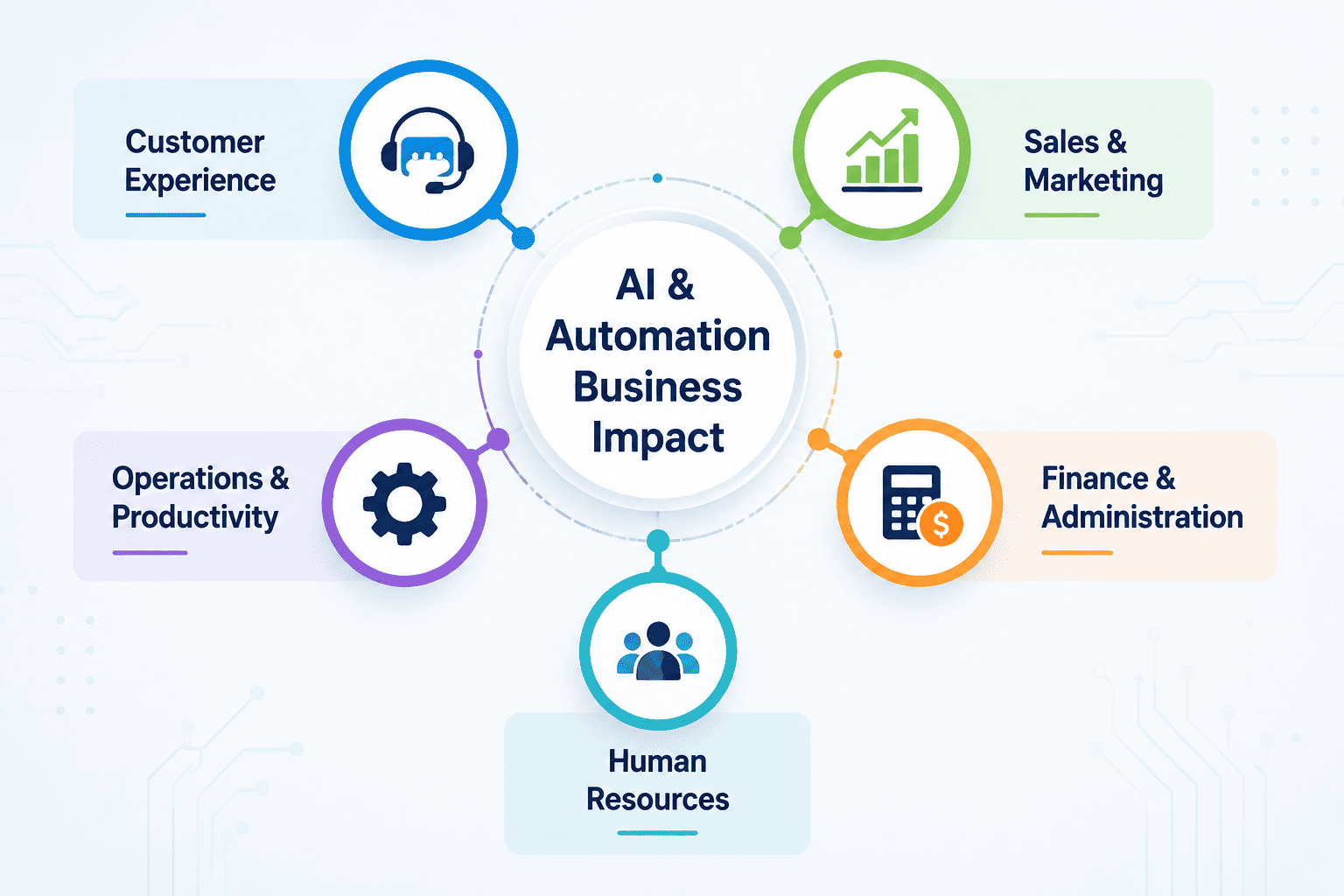
Customer Support and Experience
Customer expectations for faster and personalized service are increasing. AI enables businesses to provide instant support while reducing the workload on customer service teams.
Key AI opportunities include:
- AI chatbots for instant customer query resolution
- AI voice assistants for automated phone support
- Intelligent ticket classification and routing
- Customer sentiment analysis
- 24/7 customer assistance
Example: A retail business can integrate an AI customer assistant with its product database and CRM system to answer customer questions about product availability, pricing, order tracking, and returns without manual intervention.
Sales and Marketing
AI helps sales and marketing teams identify better opportunities, improve customer engagement, and make data-driven decisions.
AI applications include:
- Automated lead qualification and scoring
- Customer segmentation based on behavior
- Personalized marketing campaigns
- Sales forecasting and pipeline analysis
- AI-powered CRM recommendations
Example: An AI sales assistant can analyze customer interactions, identify high-value prospects, and suggest the next best action for sales representatives.
Internal Operations and Employee Productivity
Many organizations spend significant time managing repetitive processes. AI automation can streamline daily operations and allow employees to focus on higher-value activities.
Business impact areas include:
- Workflow and approval automation
- Intelligent document processing
- Internal knowledge assistants
- Automated reporting and analysis
- Employee productivity tools
Example: An enterprise can deploy an internal AI assistant connected to company documents and systems, helping employees quickly find policies, reports, and operational information.
Finance and Administration
Finance departments manage large volumes of repetitive and data-intensive tasks. AI can improve accuracy while reducing manual effort.
AI opportunities include:
- Automated invoice processing
- Expense verification
- Financial reporting automation
- Data analysis and forecasting
- Compliance monitoring support
Human Resources
AI can transform HR operations by improving recruitment, employee support, and knowledge management.
Common AI use cases include:
- Recruitment workflow automation
- Candidate screening assistance
- Employee self-service assistants
- HR knowledge management systems
- Personalized learning recommendations
By identifying these opportunities through an AI readiness assessment, businesses can prioritize AI initiatives that deliver measurable improvements and create a scalable AI transformation strategy.
AI Assistants to Existing Business Systems
Modern businesses do not always need to rebuild or replace their existing software systems to adopt AI. Instead, AI assistants can work as an intelligent layer on top of existing platforms, helping employees, customers, and teams access information faster and automate complex workflows.
By integrating with existing business systems, AI assistants transform traditional software into smarter, more efficient solutions.
CRM Systems
AI assistants integrated with CRM platforms help sales and customer teams improve productivity by:
- Finding customer information instantly
- Summarizing customer conversations and interactions
- Suggesting personalized follow-up actions
- Identifying customer trends and purchase opportunities
- Providing sales insights for better decision-making
ERP Systems
AI assistants connected with ERP systems help organizations analyze business operations more effectively through:
- Real-time business insights
- Inventory performance analysis
- Automated reports and summaries
- Process improvement recommendations
- Faster access to operational data
Internal Knowledge Systems
Employees often spend significant time searching through documents, policies, and internal resources. AI-powered knowledge assistants allow teams to interact with company information through natural conversations.
Employees can quickly find answers, access documents, understand processes, and retrieve important information without manually searching multiple systems.
AI Voice Agents
AI voice assistants enable businesses to create smarter customer interactions by handling:
- Customer support conversations
- Appointment scheduling
- Lead qualification and generation
- Customer verification processes
- Service inquiries
AI does not replace existing business systems; it enhances them with intelligence, automation, and conversational capabilities. By connecting AI assistants with current platforms, businesses can improve efficiency, reduce manual effort, and create more scalable operations without disrupting their existing technology investments.
How an AI Audit for Business Works
A professional AI Audit for Business follows a structured approach to identify where artificial intelligence can create measurable business value. Instead of recommending AI tools without context, the audit focuses on business goals, operational challenges, technology readiness, and implementation feasibility.
Understanding Business Goals
The process starts by analyzing:
- Business objectives and growth plans
- Current operational challenges
- Department-level requirements
- Efficiency and productivity goals
AI recommendations are aligned with business outcomes rather than following technology trends.
Reviewing Existing Processes and Systems
The audit evaluates existing:
- Business workflows and operations
- Software platforms and applications
- Data sources and information flow
- Employee tasks and manual processes
This helps identify areas where AI can improve efficiency and reduce repetitive work.
Identifying AI Opportunities
Experts analyze processes to discover:
- AI automation opportunities
- AI assistant use cases
- Customer experience improvements
- Data-driven decision-making opportunities
Evaluating Data and Technology Readiness
Since AI depends on quality data, the audit reviews:
- Data availability and accuracy
- Security and compliance requirements
- System integration capabilities
- Infrastructure readiness
Prioritizing AI Initiatives
AI projects are ranked based on:
|
Factor |
Evaluation |
|
Business Impact |
Revenue growth, efficiency, customer benefits |
|
Complexity |
Development and integration effort |
|
Investment |
Required resources and cost |
|
ROI Potential |
Expected business value |
Creating an AI Implementation Roadmap
The final outcome includes recommended AI solutions, implementation timelines, required technologies, and success metrics, helping businesses move from AI planning to practical execution.
AI Audit Report: What Businesses Receive
An AI Audit Report gives business leaders a clear roadmap for adopting AI with confidence. It transforms analysis into actionable recommendations by identifying where AI can improve efficiency, reduce costs, and create measurable business value.
A comprehensive report includes:
- AI Readiness Assessment: Evaluation of technology maturity, data availability, existing systems, and overall AI adoption capability.
- Business Process Analysis: Identification of manual workflows, operational challenges, and areas where AI can improve performance.
- AI Opportunity Mapping: Discovery of high-impact automation opportunities such as customer support automation, sales intelligence, document processing, and workflow optimization.
- Recommended AI Solutions: Suggestions for AI chatbots, voice assistants, AI copilots, and intelligent automation platforms.
- Business Impact Analysis: Expected outcomes including time savings, cost reduction, productivity improvement, and enhanced customer experience.
- Technology & Implementation Recommendations: Required integrations, AI platforms, security considerations, and deployment approach.
The report also prioritizes initiatives into quick wins, medium-term projects, and long-term AI transformation strategies, helping organizations create a practical AI implementation roadmap.
Why AI Audit Should Be the First Step in Your AI Journey
Successful AI adoption does not start with purchasing AI tools or implementing technology without direction. It starts with understanding your business challenges, processes, and opportunities where AI can create real impact.
An AI Audit for Business helps organizations identify high-value automation opportunities, evaluate AI readiness, define the right AI transformation strategy, and create a practical implementation roadmap. By taking a structured approach, businesses can reduce unnecessary investments, improve operational efficiency, and implement AI solutions that deliver measurable outcomes.
Whether you want to automate workflows, enhance customer experiences, or introduce AI-powered business solutions, the right strategy is essential for long-term success.
If your business is exploring AI adoption, WOWinfotech can help you conduct an AI Audit for Business. Our experts review your existing processes, identify AI opportunities, and provide consulting support to recommend the right AI solutions aligned with your business goals.
Frequently Asked Questions
-

Team WOWinfotech
WOWinfotechJul 30,2026