
What is an AI-Native Organization? How to Build an AI-Native Enterprise
An AI-native organization is a business built around artificial intelligence (AI) from the ground up. AI forms the foundation of its business model, data infrastructure, workflows, and decision-making. Unlike AI-enabled companies that add chatbots or copilots to existing processes, AI-native enterprises redesign how work gets done.
They integrate generative AI, machine learning, AI agents, and intelligent automation into core business operations. Their teams, technology, and governance are designed to work with AI at scale. AI is not just a supporting tool. It is essential to how the business operates, delivers value, and grows.
What is an AI-Native Organization?
An AI-native organization is a business built around artificial intelligence (AI) from the ground up. AI powers its data, workflows, and decisions.
Unlike AI-enabled companies, it does not simply add AI tools to existing processes. It redesigns core operations using generative AI, machine learning, and AI agents.
AI-Native vs AI-Enabled vs AI-First Organizations
AI-native, AI-enabled, and AI-first are related terms, but they describe different levels of AI integration.
|
Organization Type |
Meaning |
Example |
|
AI-enabled |
Uses AI to improve existing tasks or systems. |
AI summarizes customer support tickets. |
|
AI-first |
Prioritizes AI when designing products, processes, and business strategies. |
A company redesigns its customer service model around AI assistance. |
|
AI-native |
Builds its architecture, workflows, and operating model around AI intelligence. |
AI agents manage appropriate customer service workflows with context, tools, feedback, and human oversight. |
AI-enabled organizations use AI to support employees, while AI-first organizations prioritize AI to automate key business processes. AI-native organizations embed autonomous AI agents into end-to-end operations, enabling intelligent decision-making and task execution.
Success depends on aligning AI capabilities with business processes, workforce skills, employee roles, and risk governance.
What Does AI-Native Mean in Business?
AI-native means building business operations around artificial intelligence from the beginning. AI becomes a core part of how a company works, makes decisions, and delivers value.
An AI-native business integrates generative AI, machine learning, AI agents, and intelligent automation into its operations.
Key areas include:
- Business workflows: Automating tasks and improving processes.
- Decision-making: Using AI and business data to support decisions.
- Customer experience: Delivering faster, more personalized services.
Characteristics of an AI-Native Enterprise
An AI-native enterprise builds its business model, workflows, and decisions around artificial intelligence. Its key characteristics include:
1. AI-Driven Operating Model
AI is part of everyday business operations, not just the IT department. It supports sales, marketing, finance, customer service, and supply chain management.
- AI-powered business operations
- Intelligent process automation
- AI-driven decision-making
2. Connected Data Foundation
AI-native organizations connect business data across systems. This gives AI models and agents the context they need to deliver accurate results.
- Unified data platforms and data warehouses
- Data integration and knowledge graphs
- RAG, metadata, and data governance
3. AI Agents for Business Tasks
AI agents help execute business workflows. They can understand goals, access enterprise data, use tools, and complete approved tasks.
- Automate repetitive business tasks
- Coordinate actions across enterprise systems
- Escalate complex tasks to human employees
4. Intelligent Workflow Design
AI-native enterprises redesign complete workflows around AI. They combine AI models, agents, APIs, software, and human expertise.
- AI-powered business processes
- Automated task coordination
- Faster workflow execution
5. Human Oversight and AI Governance
AI works with employees, not without them. Human oversight ensures responsible AI use, data security, and compliance.
- Human approval for high-risk decisions
- AI security and access controls
- Responsible AI policies
How to Build an AI-Native Enterprise in 2026
Building an AI-native enterprise means designing business operations around AI. It requires the right strategy, data, technology, workflows, governance, and employee skills.
Follow these 10 steps to build an AI-native organization.
Step 1: Define Your AI-Native Strategy
Start with clear business goals. Identify where AI can improve performance.
Focus on outcomes such as:
- Faster customer service
- Lower operating costs
- Better business decisions
- Higher employee productivity
- Faster product development
Set trackable goals. For example, aim to reduce customer support time instead of simply deploying more AI agents.
Step 2: Assess Your Existing Capabilities
Review your current technology, data, workflows, and employee skills.
Evaluate:
- Existing AI tools and applications
- Enterprise data quality
- Cloud and IT infrastructure
- Business process maturity
- Employee AI skills
- Security and compliance needs
Identify gaps before investing in new AI systems. This helps create a practical transformation plan.
Step 3: Identify High-Value AI Use Cases
Choose business processes where AI can deliver trackable value.
Start with areas such as:
- Customer support
- Sales and marketing
- Document processing
- IT service management
- Supply chain and inventory planning
- Enterprise knowledge management
Prioritize use cases based on business value, cost, feasibility, and risk.
Step 4: Redesign Workflows Around AI
Do not just add AI tools to existing processes. Redesign workflows around AI capabilities.
Identify tasks AI can automate, decisions that need human judgment, and actions that require approval.
For example, AI agents can research sales leads, prepare customer insights, draft emails, and update CRM records. Sales teams can focus on customer relationships and important decisions.
Step 5: Build an Enterprise AI Architecture
Create an AI architecture that connects enterprise data, AI models, agents, and business applications.
Key components include:
- Data layer: Databases, data warehouses, and business data.
- Knowledge layer: Enterprise search, knowledge graphs, and retrieval-augmented generation (RAG).
- AI model layer: Large language models (LLMs), machine learning, and multimodal AI.
- Agent layer: AI agents, orchestration, and task execution.
- Integration layer: APIs, connectors, and enterprise systems.
- Application layer: AI-powered products, copilots, and business tools.
- Governance layer: Security, access control, monitoring, and human oversight.
The architecture should support scalability, interoperability, and reliable AI operations.
Step 6: Deploy AI Agents With Clear Roles
AI agents help automate tasks and execute business workflows. Give each agent a clear purpose and defined permissions.
For example, an IT support agent can answer employee questions, search internal documents, create tickets, and perform approved troubleshooting tasks.
Set clear limits for sensitive actions. Require human approval for high-risk decisions.
Step 7: Establish Responsible AI Governance
Build AI governance into every stage of development and deployment.
Focus on:
- Data privacy and security
- AI risk management
- Model accuracy and evaluation
- Bias detection
- Access control
- Human oversight
- Audit logs and compliance
Define who owns each AI system and how its performance is monitored.
Frameworks such as the NIST AI Risk Management Framework and ISO/IEC 42001 can support responsible AI governance.
Step 8: Build Employee AI Skills
Employees need the skills to work effectively with AI systems.
Focus on:
- AI literacy
- Prompt engineering
- Data literacy
- AI output evaluation
- Workflow automation
- Human-AI collaboration
- Responsible AI practices
Provide role-based training. Help employees understand how to use AI tools, review their outputs, and manage AI-powered workflows.
Step 9: Track AI Performance
Track business results, not just AI adoption. Track metrics such as:
|
Area |
Example Metrics |
|
Productivity |
Time saved, task completion time |
|
Customer experience |
Satisfaction, resolution time |
|
Operations |
Operating costs, error rates |
|
AI reliability |
Failure and escalation rates |
|
Security |
Security incidents, access violations |
|
Business value |
Revenue growth, cost savings |
|
Workforce |
Employee adoption, skill development |
Set performance targets before deployment. Compare AI-powered workflows with existing processes to track real improvements.
Step 10: Scale AI Across the Enterprise
Expand AI solutions after they demonstrate business value. Build reusable AI components, shared data systems, and common governance policies.
Focus on:
- Reusable AI agents and workflows
- Enterprise-wide data access
- Standard AI evaluation methods
- Secure system integrations
- Continuous employee training
- AI performance monitoring
The goal is to make AI a core part of every relevant business function. A mature AI-native enterprise uses shared AI capabilities to improve operations, products, customer experiences, and business decisions.
Benefits of Building an AI-Native Enterprise
An AI-native enterprise uses artificial intelligence, machine learning, and AI agents across business operations. This helps improve efficiency, decision-making, customer experience, and business growth.
Benefits include:
- Higher Operational Efficiency: AI automates repetitive tasks and improves business workflows.
- Faster Decision-Making: AI analyzes enterprise data and provides useful business insights.
- Better Customer Experience: AI delivers faster support and personalized customer interactions.
- Greater Business Agility: AI helps organizations adapt to market changes and business needs.
- Better Knowledge Management: Enterprise AI makes company data, documents, and information easier to access.
- Continuous Process Improvement: AI identifies errors, tracks performance, and improves workflows.
- New Business Opportunities: AI supports new products, intelligent services, and AI-powered business models.
These benefits depend on effective AI implementation, data quality, employee adoption, and responsible AI governance.
AI-Native Enterprise Architecture: A Practical Overview
A strong AI-native enterprise architecture connects business processes, enterprise data, AI models, agents, and governance.
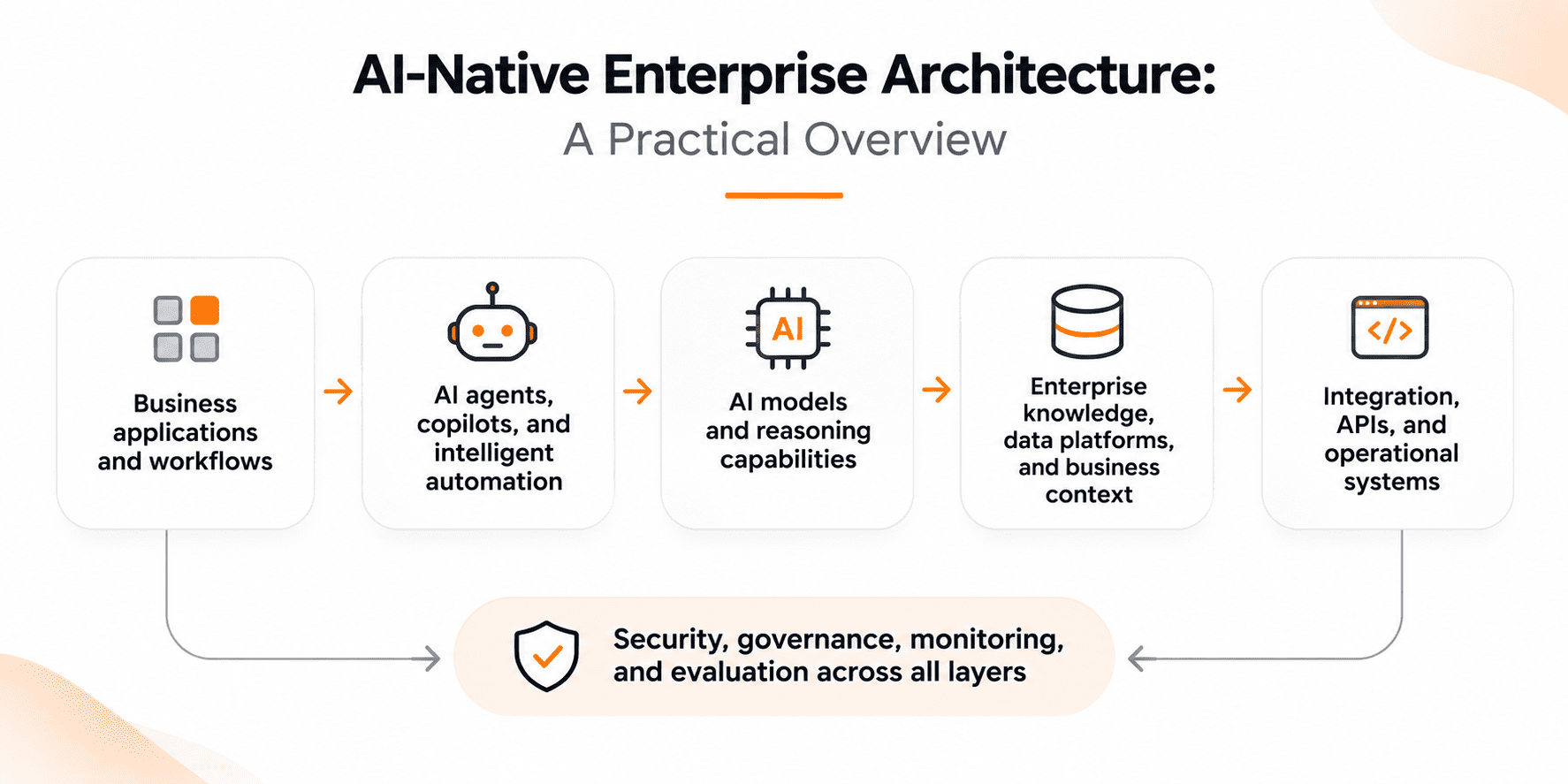
This architecture helps AI systems access data, use business applications, and perform approved tasks. It also supports feedback loops to improve results.
It must align with business processes, employee roles, skills, and risk management not just technology.
AI-Native Enterprise Trends in 2026
Key trends are shaping how businesses build AI-native organizations and transform enterprise operations.
1. Enterprise AI Agents
AI agents perform business tasks, use enterprise applications, and automate workflows. They help organizations move beyond basic AI assistance.
2. Agentic AI Workflows
Agentic AI systems plan and execute multi-step tasks. They connect AI agents, business tools, APIs, and human approvals to complete business processes.
3. Enterprise AI Governance
AI governance helps businesses manage data privacy, model risks, security, and accountability. It supports the safe and responsible use of enterprise AI.
4. AI-Native Software Development
AI supports code generation, software testing, debugging, and documentation. Developers focus more on code quality, security, and system design.
5. Human-AI Collaboration
AI handles repetitive tasks and supports business decisions. Employees provide human judgment, creativity, oversight, and accountability.
6. AI-Native Business Models
Businesses are building AI-powered products and services. These models use machine learning, generative AI, and AI agents to create new customer experiences and business value.
Real-World AI-Native Enterprise Examples
AI-native enterprises build their products, technology, and business workflows around artificial intelligence. The examples below show how organizations use AI across their core operations. However, not all of them are fully AI-native.
|
Organization |
AI-Native Capabilities |
Business Applications |
|
NVIDIA |
Builds AI computing infrastructure, GPUs, and platforms for AI development. |
Supports AI model training, deployment, accelerated computing, and enterprise AI infrastructure. |
|
Microsoft |
Integrates AI models and services across its cloud, software, and developer ecosystem. |
Uses AI in Microsoft 365, Azure, developer tools, and enterprise workflows. |
|
Amazon |
Applies AI and machine learning across its digital and physical operations. |
Supports logistics, demand forecasting, product recommendations, and customer experience. |
|
AI-Native Startups |
Design products and business models around AI from the beginning. |
Build AI coding assistants, customer support platforms, research assistants, and AI agent-based workflows. |
These examples show different levels of AI integration. A truly AI-native enterprise designs its core architecture, data, workflows, and decision-making around AI not just individual AI tools.
Conclusion
An AI-native organization embeds AI into its core business operations using AI agents, machine learning, and intelligent automation. This improves productivity, decision-making, workflow efficiency, and customer experience. Success requires strong data, scalable architecture, skilled teams, robust governance, and responsible AI practices.
Frequently Asked Questions
-

Team WOWinfotech
WOWinfotechNov 04,2026