
AI-Powered Mobile App Development in Mumbai: Features & Cost
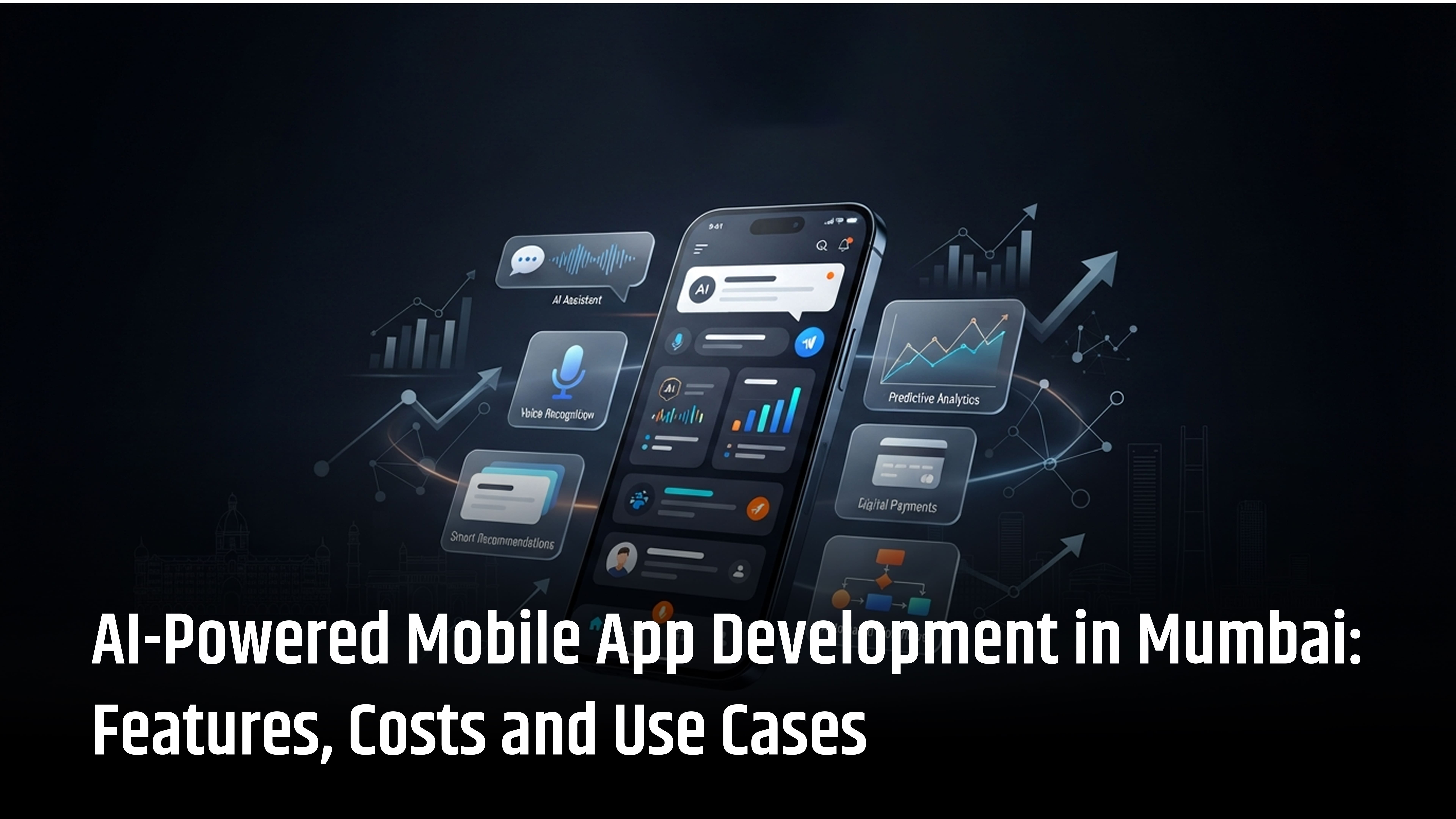
Artificial intelligence is changing how businesses build, manage and improve mobile applications. In Mumbai, companies are exploring AI-powered solutions to improve customer experiences, automate daily operations and deliver smarter digital services.
From personalised shopping recommendations and AI chatbots to predictive analytics and intelligent healthcare applications, AI is creating new opportunities for mobile app development across industries.
India's growing focus on artificial intelligence is also driving this shift. The IndiaAI Mission, approved in 2024 with an outlay of ₹10,371.92 crore, aims to strengthen the country's AI ecosystem through computing infrastructure, innovation and skill development.
Businesses need to choose AI features that solve real problems and improve user experiences. This guide covers AI app features, use cases, development costs and how to choose mobile app development services in Mumbai.
Traditional Mobile Apps vs AI-Powered Mobile Apps
Traditional mobile apps follow predefined rules, while AI-powered mobile apps use machine learning and intelligent algorithms to understand user behaviour, automate tasks and deliver personalised experiences.
|
Comparison |
Traditional Mobile App |
AI-Powered Mobile App |
|
Functionality |
Follows predefined rules |
Can analyse data and generate predictions |
|
User experience |
Mostly fixed workflows |
Can provide personalised experiences |
|
Customer support |
FAQs and manual support |
AI chatbots and virtual assistants |
|
Search |
Keyword-based search |
Can support semantic and voice search |
|
Data analysis |
Basic reports |
Predictive analytics and pattern recognition |
|
Automation |
Rule-based automation |
AI-assisted decision-making |
|
Recommendations |
Fixed categories |
Behaviour-based suggestions |
AI does not replace traditional application development. It extends application functionality by introducing data-driven capabilities.
A successful application still needs good user interface design, reliable APIs, database management, security, testing and maintenance.
Why Are Mumbai Businesses Investing in AI Mobile Applications?
Mumbai businesses are adopting AI mobile applications to automate operations, improve customer experiences and make better business decisions.
- Better Customer Engagement: AI chatbots, voice assistants and personalised recommendations help businesses understand customer needs and improve user satisfaction.
- Business Process Automation: AI automates repetitive tasks such as customer support, appointment scheduling, document processing and order management.
- Data-Driven Decisions: Machine learning and predictive analytics help businesses understand customer behaviour, forecast demand and identify business app trends.
- Growing Fintech and Enterprise Demand: Mumbai's banking, financial services, retail and media sectors are creating new opportunities for AI-powered mobile solutions.
- Improved Business Efficiency: AI integration reduces manual work, streamlines workflows, and improves application performance.
With growing AI adoption, businesses are investing in mobile app development in Mumbai to build smarter, scalable and user-friendly digital solutions.
Important AI Features Used in Mobile App Development
AI-powered mobile applications use different technologies to improve user experiences, automate tasks and support business decisions. The right features depend on the app's purpose, target audience, available data and business goals.
Here are 10 important AI features businesses can integrate into mobile applications.
1. AI Chatbots and Virtual Assistants
AI chatbots help users interact with mobile applications through text or voice. They use Natural Language Processing (NLP) and Large Language Models (LLMs) to understand questions and provide relevant responses.
Unlike traditional rule-based chatbots, AI assistants can understand context and handle more natural conversations.
Common uses include:
- Answering customer queries.
- Sharing product and service information.
- Tracking orders and deliveries.
- Booking appointments.
- Guiding users through app features and transactions.
Example: A healthcare app can use an AI chatbot to help patients find specialists, check appointment availability and understand booking procedures.
For accurate responses, chatbots should use reliable information and direct users to human support when needed.
2. Machine Learning and Predictive Analytics
Machine Learning (ML) helps mobile applications identify patterns in data and make predictions. It analyses historical information to support better business decisions.
Common uses include:
- Predicting product demand.
- Identifying customers at risk of leaving.
- Estimating delivery delays.
- Forecasting inventory requirements.
- Detecting unusual user activity.
Example: A retail app in Mumbai can analyse previous sales, seasonal trends and customer activity to predict product demand and plan inventory.
Prediction accuracy depends on data quality, model performance and regular updates.
3. Personalised Recommendations
AI recommendation systems analyse user preferences, browsing history and past interactions to suggest relevant products, services or content.
They commonly use collaborative filtering, content-based filtering and hybrid recommendation models.
Common uses include:
- Product suggestions in e-commerce apps.
- Movie and video recommendations.
- Course suggestions in education apps.
- Restaurant recommendations in food delivery apps.
- Personalised fitness and wellness plans.
Example: A fashion shopping app can recommend clothing based on a user's preferred styles, browsing activity and previous purchases.
Businesses should use personal data responsibly and provide appropriate privacy controls.
4. Computer Vision and Image Recognition
Computer vision enables mobile applications to understand and analyse images and videos. It supports tasks such as object detection, image classification, document scanning and visual inspection.
Common uses include:
- Scanning identity and business documents.
- Identifying products from photographs.
- Detecting damaged goods.
- Supporting visual product searches.
- Recognising objects in learning applications.
- Inspecting images in field operations.
Example: An e-commerce app can allow customers to upload a product image and find visually similar items.
Applications using facial recognition or biometric data need additional privacy, security and legal safeguards.
5. Natural Language Processing (NLP)
Natural Language Processing helps mobile applications understand, interpret and process human language. It allows users to search, communicate and access information using everyday words.
Common uses include:
- Sentiment analysis.
- Text classification.
- Language translation.
- Voice-to-text conversion.
- Text summarisation.
- Semantic search.
- Customer feedback analysis.
Example: A customer support app can analyse customer reviews to identify common complaints and understand user sentiment.
Multilingual NLP can also support Indian languages such as English, Hindi and Marathi, depending on the technology and target audience.
6. Voice Recognition and Voice Search
Voice recognition allows users to interact with mobile applications through spoken commands. Speech recognition converts speech into text, while NLP helps the application understand the user's request.
Common uses include:
- Searching for products using voice.
- Booking appointments through spoken commands.
- Dictating notes and messages.
- Controlling app features.
- Finding information without typing.
Example: A travel app can let users search for destinations, check bookings or find travel information through voice commands.
Developers should test voice features across different accents, background noise conditions and regional languages.
7. Generative AI Integration
Generative AI enables mobile applications to create, rewrite, summarise and organise content based on user instructions. Developers can integrate Large Language Models (LLMs) and other AI services through APIs.
Common uses include:
- AI writing assistants.
- Automated email drafts.
- Product description generation.
- Document summarisation.
- Conversational search.
- Educational content generation.
- Meeting and voice-note summaries.
Example: A business management app can use generative AI to summarise reports, prepare meeting notes and create first drafts of business emails.
AI-generated content should be reviewed before being used for important medical, legal or financial decisions.
8. AI-Based Fraud Detection
AI-based fraud detection helps financial and payment applications identify suspicious transactions and unusual account activity. Machine learning models analyse transaction patterns and other permitted signals to detect potential risks.
Common uses include:
- Identifying unusual payment activity.
- Detecting suspicious login attempts.
- Flagging abnormal transaction patterns.
- Identifying potentially fraudulent accounts.
- Supporting risk assessment.
Example: A fintech app can flag a transaction that differs significantly from a user's usual spending or payment behaviour and request additional verification.
Fraud detection models need regular monitoring to reduce false alerts and missed threats.
9. Intelligent Notifications
AI-powered notifications help mobile applications send more relevant alerts based on user preferences, behaviour and activity patterns.
Unlike fixed notifications, intelligent notification systems can consider timing, relevance and user engagement.
Common uses include:
- Reminding users about unfinished tasks.
- Sending relevant product updates.
- Notifying students about upcoming lessons.
- Sharing personalised offers.
- Providing timely delivery updates.
Example: An education app can remind students to continue an unfinished lesson based on their learning activity.
Businesses should allow users to manage notification preferences and avoid sending excessive alerts.
10. On-Device AI Processing
On-device AI allows mobile applications to run supported AI models directly on a smartphone instead of sending every request to a cloud server. It can support tasks such as image recognition, speech processing and text recognition.
Key benefits include:
- Reduced dependence on internet connectivity.
- Faster responses for supported tasks.
- Less transfer of sensitive information.
- Better functionality in low-connectivity areas.
Example: A document scanning app can use on-device image recognition to detect document edges and improve image quality without sending every image to a remote server.
Performance depends on device hardware, model size, memory, battery usage and available processing power.
Technologies Used in AI-Powered Mobile App Development
AI mobile apps combine development frameworks, AI tools, backend systems, databases and cloud platforms. Each technology supports a specific function, from app development to AI integration and data management.
AI Mobile App Development Technology Stack
|
Technology Category |
Common Tools and Frameworks |
Primary Purpose |
|
Android Development |
Kotlin, Java, Android Studio |
Builds native Android apps. |
|
iOS Development |
Swift, SwiftUI, Xcode |
Builds native iOS apps. |
|
Cross-Platform Development |
Flutter, React Native |
Develops Android and iOS apps using a shared codebase. |
|
AI and Machine Learning |
Python, TensorFlow, PyTorch, Scikit-learn, ONNX Runtime |
Builds and deploys AI models. |
|
Generative AI and LLMs |
OpenAI APIs, Google Gemini APIs, Hugging Face |
Adds chatbots, content generation and AI assistants. |
|
Backend Development |
Node.js, FastAPI, Django, Spring Boot, .NET, Firebase |
Manages APIs, authentication and app logic. |
|
Databases |
PostgreSQL, MySQL, MongoDB, Firestore, Redis |
Stores and manages application data. |
|
Cloud Platforms |
AWS, Microsoft Azure, Google Cloud |
Hosts apps, databases and AI services. |
How to Choose the Right Technology Stack
Choose technologies based on your app's requirements.
- Application Type: Select native or cross-platform development.
- AI Features: Choose tools for chatbots, predictions or image recognition.
- Data Needs: Select databases based on storage and search requirements.
- Scalability: Choose infrastructure that supports future growth.
- Security: Use encryption, access controls and secure data storage.
The right technology stack helps build reliable, secure and scalable AI mobile applications.
Real-World Use Cases of AI-Powered Mobile Applications in Mumbai
Mumbai has businesses across many industries. Each industry has different needs. AI-powered mobile applications can help solve these challenges through automation, data analysis and personalised services.
Here are some common AI mobile app use cases across Mumbai's key industries.
1. Healthcare and Hospital Applications
Healthcare apps can use AI to simplify patient services and manage routine tasks. They can also help organise medical information.
Common AI features include:
- AI-powered appointment scheduling.
- Medical document scanning.
- Prescription text extraction.
- Patient support chatbots.
- Health record summarisation.
- Hospital navigation.
- Automated appointment reminders.
Example: A hospital app can use Optical Character Recognition (OCR) to extract text from uploaded medical reports. Authorised healthcare professionals can then review the information.
AI should support healthcare professionals, not replace medical judgement or provide unverified diagnoses.
2. Banking and Fintech Applications
Mumbai has a strong banking and financial services sector. AI can help these businesses improve security and customer support.
Common AI features include:
- Fraud detection.
- Real-time transaction monitoring.
- AI-powered customer support.
- Spending categorisation.
- Credit risk assessment.
- Financial activity analysis.
- Suspicious login detection.
Example: A banking app can detect unusual spending patterns. It can flag suspicious transactions and request additional verification.
Sensitive financial decisions need proper checks, governance and human oversight.
3. E-Commerce and Retail Applications
Retail businesses can use AI to understand customer preferences and improve online shopping. These features also help customers find relevant products faster.
Common AI features include:
- Personalised product recommendations.
- Visual product search.
- AI shopping assistants.
- Demand forecasting.
- Customer sentiment analysis.
- Automated product categorisation.
- Inventory insights.
Example: An online clothing store can let customers upload a product image. The app can then suggest similar clothing items.
4. Logistics and Transportation Applications
Logistics companies manage deliveries, vehicles, routes and warehouses. AI can help improve planning and daily operations.
Common AI features include:
- Estimated delivery times.
- Smart route recommendations.
- Predictive vehicle maintenance.
- Document recognition.
- Delivery image verification.
- Demand forecasting.
- Fleet performance analysis.
Example: A delivery app can analyse past delivery records and available traffic data. It can use this information to estimate arrival times.
5. Education and E-Learning Applications
Education apps can use AI to create more personalised learning experiences. They can adapt learning content to each student's progress.
Common AI features include:
- AI learning assistants.
- Automated quiz generation.
- Personalised study recommendations.
- Language learning support.
- Voice-based learning.
- Content summarisation.
- Learning progress analysis.
Example: An e-learning app can analyse a student's quiz results. It can then recommend topics that need more practice.
6. Real Estate Applications
Real estate apps can use AI to simplify property searches and improve customer support. They can also help agents manage property enquiries.
Common AI features include:
- Personalised property recommendations.
- Property price trend analysis.
- Image-based property categorisation.
- AI virtual assistants.
- Lead qualification.
- Property document extraction.
Example: A user can search for a two-bedroom apartment in Andheri within a specific budget. They can enter the request in everyday language. The app can convert it into property filters and show relevant listings.
These features can make property searches faster and more convenient for buyers and agents.
AI-Powered Mobile App Development Cost in Mumbai
How much does AI mobile app development cost in Mumbai? The cost depends on app complexity, features, platform, AI model, integrations, data and security requirements.
The following are indicative cost estimates for 2026, not fixed prices or vendor quotations.
Estimated AI Mobile App Development Cost
|
Application Type |
Typical Scope |
Estimated Cost |
|
Basic AI-enabled app |
Login, basic screens, simple chatbot or AI API integration |
₹5-10 lakh |
|
Medium-complexity app |
User profiles, payments, AI chatbot, recommendations and admin panel |
₹10-20 lakh |
|
Advanced AI application |
Computer vision, predictive analytics, advanced workflows and integrations |
₹20-35 lakh |
|
Enterprise AI application |
Custom AI models, large-scale infrastructure, multiple roles and complex integrations |
₹35-50 lakh+ |
These estimates are broad project-budget ranges. A focused prototype or proof of concept may cost less, while a regulated enterprise platform can cost substantially more.
Factors That Affect AI App Development Cost
- Application Complexity: More features and workflows increase costs.
- AI Model Selection: Custom AI models cost more than existing APIs.
- Data Preparation: Collecting and cleaning data adds expenses.
- Platform Selection: Native apps may cost more than cross-platform apps.
- Third-Party Integrations: External APIs and business tools increase costs.
- UI/UX Design: Custom designs and multilingual support require extra work.
- Security and Compliance: Data protection measures add to the budget.
- Testing and Maintenance: Regular testing, updates and bug fixes create ongoing costs.
Additional Costs After App Development
The initial development cost is only part of the total investment. Businesses should also budget for ongoing expenses, such as:
- Cloud hosting and database services.
- AI API usage fees.
- SMS and email notification charges.
- Payment gateway fees.
- App Store and Google Play developer account fees.
- Security audits and updates.
- Bug fixes and technical support.
- AI model monitoring and evaluation.
- Data storage and backups.
Businesses can use 15-20% of the initial development cost as a starting annual maintenance budget. This is only a planning estimate. Actual costs depend on app complexity, AI usage and infrastructure needs. Major upgrades may require a separate budget.
Data Privacy and Security in AI Mobile App Development
AI mobile apps may handle personal, financial, medical and location data. Businesses must protect this information from the start.
In India, businesses should follow applicable data protection laws, including the Digital Personal Data Protection Act, 2023, and the DPDP Rules, 2025. They should also check the relevant implementation timelines.
Important security practices include:
- Collect only necessary user data.
- Explain how personal data is used.
- Obtain consent where required.
- Encrypt sensitive information.
- Use strong access controls.
- Protect API keys and login credentials.
- Set clear data retention and deletion policies.
- Review third-party AI services.
- Test applications for security risks.
- Monitor AI models and their outputs.
Developers can use the OWASP Mobile Application Security Verification Standard (MASVS) as a security guide.
AI applications also need protection against data leaks, prompt injection and inaccurate outputs. Regular monitoring and security updates help keep user data safe.
Conclusion
AI-powered mobile apps help businesses improve customer experiences, automate tasks and make better decisions. For companies planning Mobile App Development in Mumbai, the right AI features depend on their goals, users and budget. Development costs can range from ₹5 lakh to ₹50 lakh or more, based on app complexity, AI models and integrations.
Choosing the right technology partner is equally important. WOWinfotech offers mobile app development services to help businesses build secure, scalable and user-friendly AI applications. Contact WOWinfotech today to discuss your app idea and get started.
Frequently Asked Questions
-

Team WOWinfotech
WOWinfotechNov 23,2026