
Types of Artificial Intelligence for Enterprise Transformation
Every business has data, but how can it turn that data into better decisions and real business growth? Enterprise AI helps bridge this gap.
It uses technologies such as machine learning, generative AI, natural language processing (NLP), and computer vision. These tools help businesses automate workflows, predict trends, reduce costs, and improve operational efficiency.
But not every AI technology solves the same problem. Some predict sales, while others generate content, detect defects, or automate tasks. Choosing the right AI depends on your business goals.
In this guide, we explore the main types of AI for enterprise transformation, their real-world applications, and benefits. You will also learn how to choose the right AI solutions for your business in 2026.
Enterprise AI Overview
Enterprise AI uses artificial intelligence to automate business processes, analyze data, and improve decision-making.
It integrates technologies like machine learning, NLP, computer vision, predictive analytics, and generative AI with business systems such as ERP and CRM.
For example, manufacturers use AI to predict equipment failures, detect product defects, and summarize maintenance records. These applications improve productivity, efficiency, and business performance.
How Does Enterprise AI Work?
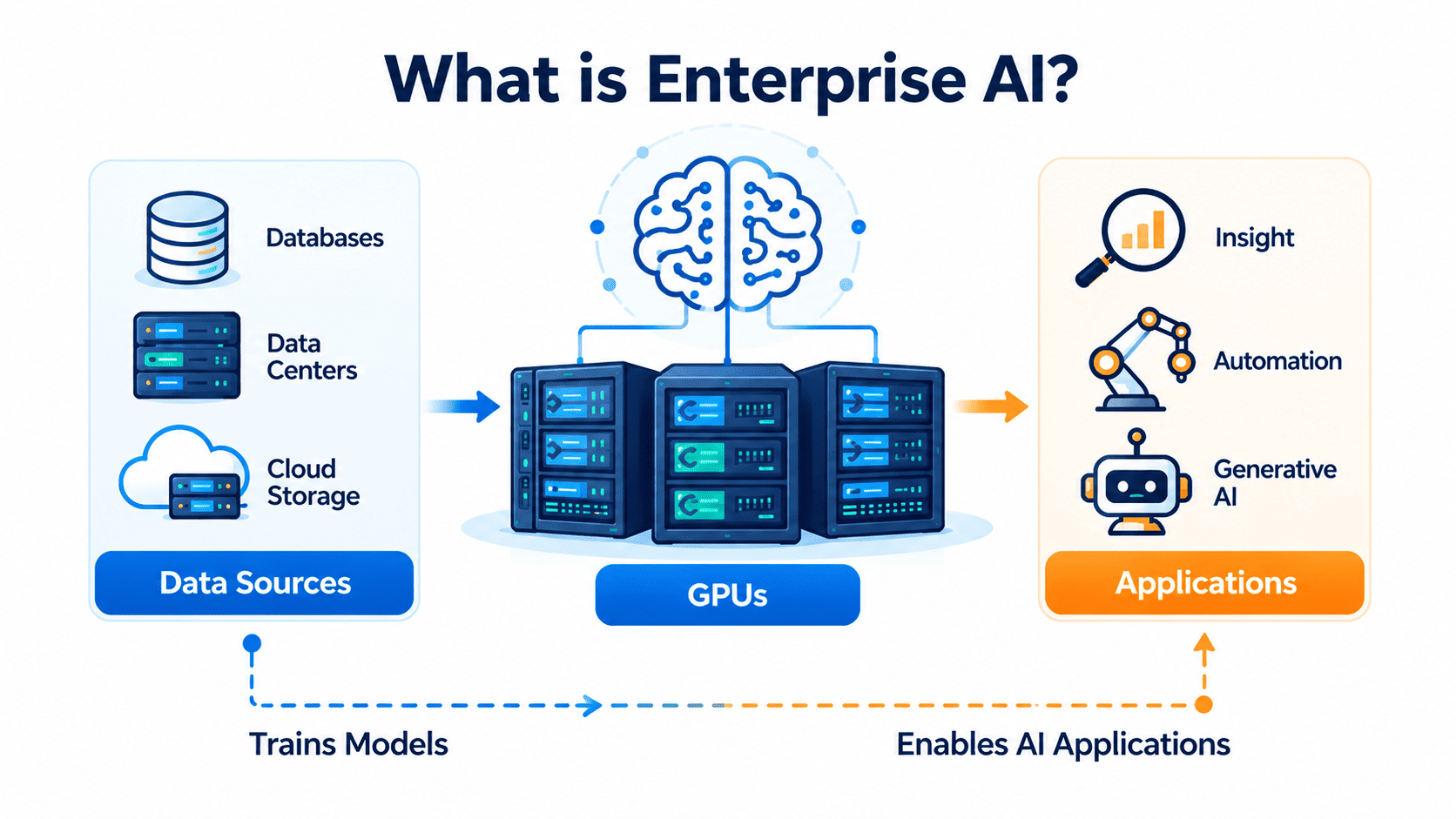
Enterprise AI connects business data, AI models, and workflows to solve business problems. It uses five key components:
- Business Data: Collects information from CRM systems, ERP platforms, databases, documents, and sensors.
- AI Models: Analyze data, identify patterns, generate content, and predict outcomes.
- IT Infrastructure: Provides cloud platforms, servers, APIs, and data pipelines to run AI systems.
- Business Workflows: Integrate AI outputs into daily tasks, operations, and decision-making.
- AI Governance and Human Oversight: Protects data, monitors accuracy, and ensures responsible AI use.
The setup depends on the business need. A forecasting model may use sales data to predict demand. An AI agent may need system access, workflow monitoring, and human approval.
The goal of enterprise AI is to improve efficiency, automate processes, and support better business decisions securely and reliably.
What Are the Main Types of AI for Enterprise Transformation?
The main types of AI for enterprise transformation include machine learning, deep learning, NLP, computer vision, predictive analytics, generative AI, RAG, RPA, and AI agents.
These technologies help businesses automate workflows, analyze data, improve decision-making, and accelerate digital transformation.
Each AI technology serves a different purpose. For example:
- Machine learning predicts outcomes using data.
- Computer vision analyzes images and videos.
- Generative AI creates content and summaries.
- Predictive analytics forecasts future trends.
- AI agents perform multi-step tasks using approved tools.
Businesses can combine these technologies to improve efficiency, reduce errors, and automate enterprise workflows.
Quick Comparison of Enterprise AI Types :
|
Type of AI |
Main function |
Business application |
|
Machine learning |
Learns patterns from data |
Customer churn prediction |
|
Deep learning |
Identifies complex patterns |
Image and speech recognition |
|
Processes human language |
Document analysis |
|
|
Computer vision |
Analyzes visual data |
Quality inspection |
|
Predictive analytics |
Forecasts future outcomes |
Demand forecasting |
|
Generative AI |
Creates new content |
Report generation |
|
Retrieval-augmented generation (RAG) |
Retrieves information for AI responses |
Enterprise knowledge search |
|
Robotic process automation (RPA) |
Automates repetitive tasks |
Invoice processing |
|
Coordinates multi-step tasks |
Workflow automation |
|
|
Recommendation systems |
Suggests relevant options |
Product recommendations |
These technologies can work together.
For example, machine learning can forecast product demand. Generative AI can summarize sales reports. AI agents can help coordinate inventory tasks.
The right combination depends on business goals, data quality, security, and existing systems.
1. Machine Learning (ML)
Machine learning enables computers to learn patterns from data. It uses these patterns to make predictions, classifications, and recommendations.
Businesses use machine learning for:
- Customer churn prediction.
- Fraud detection.
- Sales forecasting.
- Inventory management.
- Predictive maintenance.
For example, retailers analyze past sales and seasonal trends to forecast product demand. This helps them plan inventory and reduce stock shortages. Machine learning performance depends on data quality and regular monitoring.
2. Deep Learning
Deep learning is a branch of machine learning. It uses multilayer neural networks to identify complex patterns.
It works well with images, audio, video, and language data.
Common enterprise applications include:
- Detecting product defects in manufacturing.
- Recognizing speech in customer service calls.
- Extracting information from complex documents.
- Analyzing images in approved healthcare workflows.
For example, manufacturers use deep learning to identify defects on production lines. This supports quality control and reduces manual inspection.
Deep learning may require more data and computing power than simpler machine learning methods.
3. Natural Language Processing (NLP)
Natural language processing enables computers to process and analyze human language. It helps businesses understand text from emails, contracts, reviews, and support tickets.
Common NLP applications include:
- Sentiment analysis: Identifies customer opinions.
- Text classification: Groups documents by topic.
- Text summarization: Shortens long documents.
- Entity extraction: Identifies names, dates, and key details.
For example, customer service teams can use NLP to group similar complaints. This helps them identify recurring issues and improve service quality.
NLP also supports chatbots, document analysis, and enterprise knowledge management.
4. Computer Vision
Computer vision enables AI systems to analyze images and videos. It helps businesses identify objects, detect defects, and interpret visual information.
Common applications include:
- Manufacturing: Detects product defects.
- Retail: Helps monitor shelf availability.
- Logistics: Reads package labels.
- Construction: Supports site monitoring.
For example, a factory can use cameras to inspect products on a production line. The system flags suspected defects for review.
Computer vision requires suitable images, reliable lighting, and testing in real operating conditions.
5. Predictive Analytics
Predictive analytics uses historical data, statistical models, and machine learning to forecast future outcomes.
Businesses use it to:
- Forecast sales and product demand.
- Predict customer churn.
- Estimate equipment failure risks.
- Improve cash-flow planning.
- Identify supply chain disruptions.
For example, a distributor can analyze sales history, inventory levels, and supplier lead times. This helps the team anticipate shortages and plan purchases.
Predictive analytics supports better planning. However, its accuracy depends on data quality and changing market conditions.
6. Generative AI
Generative AI creates content based on learned patterns and user instructions. It can generate text, code, images, and summaries.
Enterprises use generative AI for:
- Drafting reports and business documents.
- Summarizing long files.
- Assisting software development.
- Preparing customer support responses.
- Creating training materials.
For example, employees can use generative AI to prepare a first draft of a business report. They should verify the facts before sharing it.
Generative AI can save time. However, it may produce inaccurate information or expose sensitive data if used incorrectly.
Related reading: [Generative AI Use Cases for Business]
7. Retrieval-Augmented Generation (RAG)
Retrieval-augmented generation combines information retrieval with generative AI. It retrieves relevant information from approved sources before generating an answer.
Businesses use RAG for:
- Internal policy assistants.
- Technical documentation search.
- Employee knowledge management.
- Customer support.
- Contract and document research.
For example, an employee can ask about a company policy. The system retrieves the relevant document and generates an answer based on its contents.
RAG can improve response relevance. However, results still depend on document quality, retrieval accuracy, and access permissions.
8. Robotic Process Automation (RPA)
Robotic process automation uses software bots to perform repetitive, rule-based tasks. It helps businesses reduce manual work across applications.
Common RPA use cases include:
- Invoice processing.
- Data entry.
- Order processing.
- Report generation.
- Employee onboarding.
For example, an RPA bot can transfer approved invoice details into accounting software. AI can also extract information from invoices before the bot processes the data.
RPA works best with structured tasks and stable rules. Complex cases may require human review.
9. AI Agents and Agentic AI
AI agents use AI models and approved tools to complete tasks. They can retrieve information, interact with software, and coordinate multiple steps.
Businesses can use AI agents for:
- Customer support workflows.
- IT incident analysis.
- Procurement assistance.
- Supply chain coordination.
- Software testing support.
For example, a procurement agent can check stock levels and compare supplier information. It can then prepare a purchase recommendation.
Sensitive actions should require suitable permissions and approval. Monitoring and audit logs are also important.
10. Recommendation Systems
Recommendation systems analyze user preferences, product details, and past interactions. They suggest relevant products, services, or actions.
Common business applications include:
- E-commerce product recommendations.
- Personalized content.
- Cross-selling suggestions.
- Customer engagement.
- Relevant support articles.
For example, an online store can recommend products based on browsing history and previous purchases.
Businesses should consider privacy, fairness, and customer preferences when using recommendation systems.
Types of AI Based on Functionality
AI can also be classified by how it processes information and responds to inputs. This traditional classification includes reactive machines, limited-memory AI, theory of mind AI, and self-aware AI.
These categories explain AI concepts. They are not a list of products that businesses can purchase.
1. Reactive Machines
Reactive AI responds to current inputs. It does not rely on stored experiences from previous interactions.
Example: IBM's Deep Blue chess system evaluated possible moves to choose an action.
Features:
- Responds to current inputs.
- Does not use past interactions as memory.
- Operates within a defined task.
2. Limited-Memory AI
Limited-memory AI uses historical data or previous observations to make predictions and decisions. Many modern machine learning applications fit this category.
Common applications include:
- Predicting customer behavior.
- Detecting unusual transactions.
- Forecasting demand from past sales.
Note: Not every system learns continuously. Some models remain unchanged after training. They use historical data as input when making predictions.
3. Theory of Mind AI
Theory of Mind AI is a proposed type of AI. It would model the beliefs, intentions, emotions, or mental states of others.
Potential applications include:
- Adapting interactions to customer preferences.
- Identifying emotional or behavioral patterns.
- Supporting context-aware communication.
Current AI can recognize some emotional and behavioral signals. However, this does not prove that it understands human thoughts or feelings like a person.
4. Self-Aware AI
Self-aware AI is a hypothetical form of AI. It would have awareness of its own existence or possess machine consciousness.
Points:
- It remains a theoretical concept.
- It goes beyond ordinary data processing.
- There is no established evidence that current enterprise AI has this kind of consciousness.
Which Types of AI Should Enterprises Focus On?
Businesses should focus on AI that solves real problems. Theoretical concepts such as AGI, ASI, and self-aware AI are less relevant to immediate business decisions.
Consider these factors when choosing an AI solution:
- Business value: Can it reduce costs or save time?
- Accuracy: Does it deliver reliable results?
- Security: Can it protect sensitive data?
- Scalability: Can it support business growth?
Understanding these AI types helps businesses separate current technologies from theoretical concepts. It also supports better AI investment decisions.
How Different Types of AI Work Together in Enterprise Transformation
Different types of AI work together to improve business operations. They automate tasks, analyze data, and support better decisions. Each technology serves a specific purpose.
For example, a manufacturing company can combine AI technologies to reduce equipment downtime.
- Machine learning detects patterns that indicate equipment failure.
- Predictive analytics forecasts maintenance needs and potential downtime.
- Generative AI summarizes maintenance records and technical documents.
- AI agents help schedule maintenance and coordinate tasks.
- Human oversight ensures critical decisions receive proper review.
Businesses can use similar AI solutions in customer service, finance, procurement, and supply chain management.
The goal is to choose the right AI technology for each task. This approach improves efficiency, reduces errors, and supports enterprise digital transformation.
Benefits of AI for Enterprise Transformation
AI helps enterprises improve business processes, automate tasks, and make data-driven decisions. It also supports customer service, risk management, and business growth. Here are the key benefits of AI for enterprise transformation.
1. Improved Operational Efficiency
AI automates repetitive tasks and reduces manual work. Businesses can use intelligent automation to streamline workflows, process data faster, and improve employee productivity. This helps teams focus on higher-value activities.
2. Better Business Decision-Making
Machine learning and predictive analytics help businesses identify trends and forecast outcomes. These insights support data-driven decision-making, improve business planning, and help teams respond to changing market conditions.
3. Faster Access to Business Information
Natural language processing (NLP), generative AI, and retrieval-augmented generation (RAG) help employees find and summarize information quickly. These technologies improve enterprise knowledge management and make internal documents easier to search.
4. Improved Customer Experience
AI-powered chatbots and virtual assistants answer routine questions and provide faster support. AI can also analyze customer feedback and personalize interactions. These capabilities improve customer experience management and help service teams resolve issues efficiently.
5. Greater Process Consistency
AI-powered workflows apply defined rules across repetitive business tasks. This helps reduce manual errors and maintain consistent processes. Combined with business process automation, AI can improve quality control and operational reliability.
6. Stronger Risk Detection
Machine learning helps identify unusual transactions, suspicious activities, and operational risks. Businesses can use AI-powered fraud detection and anomaly detection to identify potential problems earlier and support risk management.
7. Scalable Business Operations
AI helps enterprises manage growing volumes of data, customer requests, and business transactions. With proper infrastructure and system integration, enterprise AI solutions can support business growth while controlling manual workload and operating costs.
How to Choose the Right Type of AI for Your Enterprise
Choose the right AI for your enterprise by aligning business goals, data quality, budget, and automation needs with the most suitable AI technology.
- Define Business Goals: Identify problems AI can solve, such as forecasting or automation.
- Assess Your Data: Check data quality, availability, and security.
- Choose the Right AI: Use machine learning for predictions, NLP for text, generative AI for content, and AI agents for complex workflows.
- Evaluate Solutions: Compare cost, accuracy, scalability, and integration.
- Run a Pilot: Test AI on a small project and measure results.
- Ensure Governance: Protect data, monitor outputs, and maintain human oversight.
- Track Success: Track efficiency, accuracy, and cost savings before scaling.
Conclusion
Understanding the types of AI helps businesses choose the right technology. AI can improve efficiency, automate workflows, analyze data, and support better decisions. Key solutions include machine learning, generative AI, predictive analytics, and AI agents. Success depends on quality data, strong security, and clear business goals.
Ready to transform your business with AI? Partner with WOWinfotech for AI solutions, intelligent automation, and enterprise AI integration. Visit WOWinfotech to explore the right approach for your business.
Frequently Asked Questions
-

Team WOWinfotech
WOWinfotechOct 26,2026