
Top 10 Agentic AI Platforms in 2026 for Business
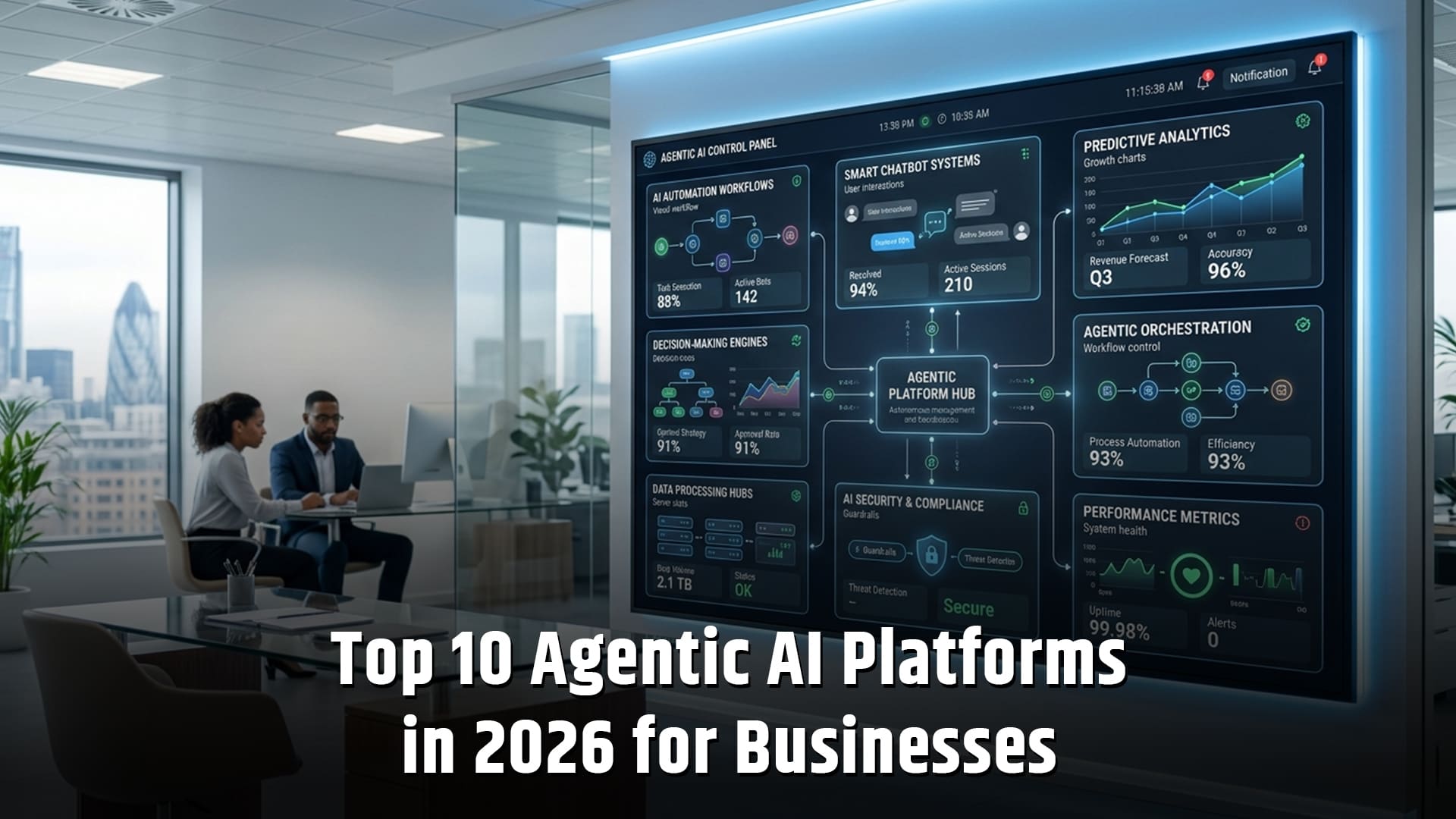
Agentic AI platforms are smart business tools that use AI agents to plan, make decisions, and complete tasks autonomously. These agents can handle complex work across different software without needing much human help.
In 2026, platforms like Creatio, UiPath, Moveworks, Microsoft Copilot Studio, Kore.ai, and TrueFoundry help businesses grow faster, automate decisions, and improve productivity by connecting tools and managing multiple AI agents efficiently.
Top 10 Agentic AI Platforms- Feature Comparison
Here is a simple breakdown of agentic AI platforms, including their features, integrations, and ideal business types.
|
Platform |
Features |
Integrations |
Ideal Business Type |
|
Creatio |
CRM + workflow automation, AI agents, drag-and-drop builder |
CRM, ERP, APIs |
SMBs & Enterprises |
|
UiPath |
RPA + AI agents, process mining, analytics |
SAP, Oracle, APIs |
Large enterprises |
|
Moveworks |
AI helpdesk, NLP search, auto-resolution |
Slack, ServiceNow |
Mid to large companies |
|
Microsoft Copilot Studio |
AI agents, workflow automation, enterprise security |
Microsoft 365, Teams, Azure |
Enterprises |
|
Kore.ai |
Chatbots, voice bots, omnichannel AI |
WhatsApp, CRM, APIs |
Enterprises & CX teams |
|
TrueFoundry |
Agent lifecycle management, monitoring, scaling |
Cloud platforms, APIs |
Tech companies |
|
Slack AI Platform |
AI inside chat, workflow automation, collaboration tools |
Slack apps, CRM, tools |
Startups & teams |
|
LangChain |
Open-source, agent orchestration, flexible workflows |
APIs, LLMs |
Developers & startups |
|
AutoGen |
Agent collaboration, complex task handling |
APIs, LLMs |
Advanced AI teams |
|
CrewAI |
Multi-agent roles, simple setup, workflow automation |
APIs |
Startups & SMBs |
Top 10 Agentic AI Platforms in 2026
Here is an explanation of agentic AI platforms, including their key features, use cases, and how they help businesses automate workflows and improve efficiency.
1. Creatio
Best for: No-code workflow automation + CRM
Creatio is a leading no-code platform that combines CRM with AI-driven workflow automation. It allows non-technical users to build and manage AI-powered processes easily.
- Combines CRM with AI agent orchestration
- Automates lead management, customer journeys, and support workflows
- Drag-and-drop interface for quick deployment
- Built-in analytics for tracking performance
- Scales easily across departments
Business Impact: Helps companies reduce manual work and improve customer experience without needing developers.
Use Case: Automating sales pipelines, customer onboarding, and marketing campaigns.
2. UiPath
Best for: Enterprise automation + RPA evolution
UiPath is a market leader in automation, now enhanced with agentic AI capabilities. It enables businesses to automate both simple tasks and complex decision-making processes.
- Combines RPA bots with AI agents
- Automates repetitive processes like invoicing and data entry
- Advanced process mining to identify automation opportunities
- Strong governance, compliance, and security controls
- Scalable across global enterprise operations
Business Impact: Reduces operational costs and increases efficiency across departments.
Use Case: Finance automation, HR onboarding, and supply chain processes.
3. Moveworks
Best for: Employee support automation
Moveworks focuses on improving internal operations by automating employee support and service requests.
- AI agents handle IT, HR, and workplace queries
- Uses advanced NLP to understand natural language
- Searches across enterprise systems to deliver accurate answers
- Automates workflows like password resets and ticket resolution
- Provides insights into employee issues and trends
Business Impact: Improves employee productivity and reduces support team workload.
Use Case: IT helpdesk automation and HR query resolution.
4. Microsoft Copilot Studio
Best for: Microsoft ecosystem integration
Microsoft Copilot Studio allows businesses to create and deploy AI agents across Microsoft tools.
- Works with Microsoft 365, Teams, Dynamics, and Azure
- Automates workflows in emails, documents, and meetings
- Integrates with enterprise data and applications
- Enterprise-grade security, compliance, and governance
- Supports low-code development
Business Impact: Improves productivity within the Microsoft ecosystem.
Use Case: Automating document processing, meeting summaries, and internal workflows.
5. Kore.ai
Best for: Conversational AI + omnichannel automation
Kore.ai helps businesses build intelligent virtual assistants for customer interaction across multiple channels.
- Prebuilt integrations with Slack, WhatsApp, web, and mobile apps
- Supports chatbots and voice bots
- Flexible deployment (cloud or on-premise)
- AI-driven customer experience (CX) automation
- Advanced analytics and reporting
Business Impact: Improves customer satisfaction and reduces response time.
Use Case: Customer support automation, virtual assistants, and contact centers.
6. TrueFoundry
Best for: AI infrastructure + agent lifecycle management
TrueFoundry is designed for building, deploying, and managing AI agents at scale.
- Full-stack platform for AI deployment
- Tracks performance with observability tools
- Ensures governance, reliability, and compliance
- Supports frameworks like LangChain and AutoGen
- Enables fast scaling of AI systems
Business Impact: Helps companies manage AI systems efficiently in production.
Use Case: Deploying enterprise AI applications and managing agent workflows.
7. Slack AI Platform
Best for: Collaborative agent workflows
Slack AI integrates AI directly into workplace communication, making collaboration smarter and faster.
- AI agents work inside Slack chats and channels
- Automates workflows like approvals and updates
- Connects with tools like Salesforce, CRM, and Google Workspace
- Supports human-in-the-loop decision-making
- Improves team productivity and communication
Business Impact: Speeds up decision-making and reduces manual coordination.
Use Case: Team collaboration, project updates, and workflow automation.
8. LangChain
Best for: Developers building custom agent systems
LangChain is a popular framework for building advanced AI applications and agent systems.
- Modular framework for creating custom workflows
- Supports multi-agent collaboration
- Works with large language models (LLMs)
- Integrates with APIs and data sources
- Strong open-source community support
Business Impact: Enables highly customized AI solutions.
Use Case: Building AI assistants, research tools, and automation systems.
9. AutoGen
Best for: Multi-agent collaboration systems
AutoGen enables multiple AI agents to collaborate and solve complex problems together.
- Supports agent-to-agent communication
- Handles multi-step reasoning workflows
- Useful for research and enterprise experimentation
- Enables complex automation scenarios
- Backed by Microsoft Research
Business Impact: Allows businesses to automate complex decision-making processes.
Use Case: Advanced analytics, research automation, and multi-agent workflows.
10. CrewAI
Best for: Role-based AI agent teams
CrewAI focuses on creating AI agents that work together as a team with defined roles.
- Assign roles like analyst, manager, or researcher
- Agents collaborate to complete tasks
- Simple and lightweight implementation
- Flexible and easy to integrate
- Mimics real-world team workflows
Business Impact: Improves efficiency by simulating human team collaboration.
Use Case: Business process automation and workflow simulation.
What is an AI Agent Workforce Platform?
An AI agent workforce platform helps businesses build and manage AI agents. These agents can handle different tasks and business processes.
Instead of using one AI agent for one task, businesses can create a team of AI agents. Each agent can have a specific role. They can also work together on complex workflows.
AI agent workforce platforms can support areas such as sales, customer support, finance, HR, IT, and operations.
Key features include:
-
Multi-agent orchestration: Manage multiple AI agents from one platform.
-
Role-based agents: Give each agent a specific business role.
-
Workflow automation: Automate multi-step business tasks.
-
System integration: Connect agents with CRMs, ERPs, APIs, and other tools.
-
Monitoring: Track agent activity and performance.
-
Human oversight: Let employees review important actions.
-
Scalability: Deploy agents across different teams and departments.
An AI agent workforce platform helps businesses move beyond simple AI assistants. It enables multiple agents to work together and automate complete business workflows.
How to Choose the Right Agentic AI Platform
Evaluate these factors:
- Scalability: Can it handle thousands of agents?
- Integration depth: APIs, SaaS tools, databases
- Security: Enterprise-grade compliance
- Ease of use: No-code vs developer-first
- Cost model: Usage vs licensing
Not all “agentic” tools are enterprise-ready many fail at scale.
Conclusion
Agentic AI platforms are changing how businesses work in 2026. They go beyond simple automation. They help businesses automate complete workflows with intelligent AI agents.
An agentic automation platform can help teams reduce manual work, improve efficiency, and scale operations. With the right platform, businesses can also manage AI agents with better control and oversight.
Looking to build AI-powered workflows for your business? Work with an experienced Agentic AI Platform Development Company in Nashik. WOWinfotech helps businesses develop scalable agentic AI solutions tailored to their needs.
Ready to automate your business with AI agents? Contact WOWinfotech today to explore your agentic AI development options.
FAQs
- Creatio -business automation
- UiPath -enterprise RPA
- TrueFoundry -infrastructure
- Kore.ai -conversational AI
- Finance
- Healthcare
- SaaS
- Retail
- Customer support
-

Krishna Handge
WOWinfotechMar 23,2026