AI Agent vs. Chatbot: What’s the Difference? (2026 Guide)
.jpg)
AI chatbots and AI agents are powerful digital solutions that use artificial intelligence to interact with users, automate tasks, and improve business efficiency. They help organizations handle everyday activities like customer support, information retrieval, workflow automation, and decision-making with minimal human effort.
In 2026, chatbots are widely used for quick conversations and support services, while advanced AI agents go beyond that by executing complex tasks, analyzing data, and integrating with multiple systems. Together, they help businesses improve productivity, reduce operational costs, and deliver smarter, faster user experiences.
What is a Chatbot?
A chatbot is an AI-powered program that simulates conversation with users. It uses natural language processing (NLP) to understand questions and provide relevant responses. Chatbots are commonly used for customer support, answering FAQs, and handling simple tasks quickly.
Characteristics:
- Responds to questions
- Uses Natural Language Processing (NLP)
- Often rule-based or script-driven
- Requires user input for each step
Example:
User: “Where is my order?”
Chatbot: “Your order will arrive tomorrow.”
What is an AI Agent?
An AI agent is an advanced AI system that can think, plan, and take actions to achieve a goal. It can use data, tools, and memory to make decisions and complete tasks with minimal human input.
Characteristics:
- Uses Large Language Models (LLMs)
- Has memory and reasoning abilities
- Can interact with tools, APIs, and systems
- Works autonomously
Example:
User: “Create a report and email it to my manager.”
AI Agent: Completes the full task without step-by-step instructions.
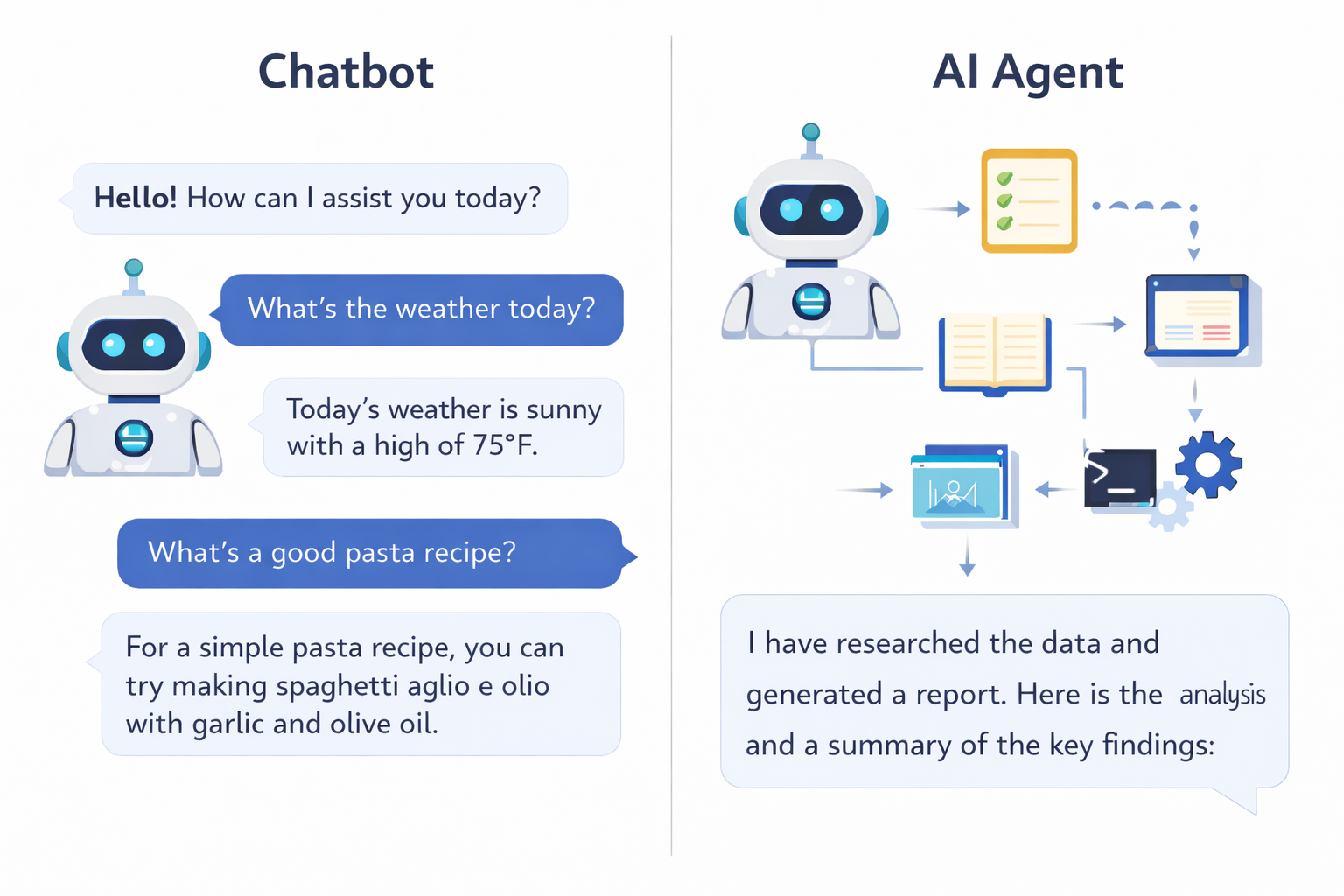
AI Agent vs Chatbot: Differences
While both AI agents and chatbots can talk to users, they work very differently. Chatbots follow simple rules to answer questions, while AI agents can think, decide, and complete tasks on their own. Chatbots are best for basic support, but AI agents are better for handling complex work and automation.
|
Feature |
Chatbot |
AI Agent |
|
Autonomy |
Responds to user input based on a script |
Can take independent actions to achieve a goal |
|
Task Complexity |
Best for simple, single-intent tasks |
Handles complex, multi-step workflows |
|
Learning & Adaptability |
Static; requires manual updates to change behavior |
Dynamic; learns from interactions and adapts over time |
|
System Integration |
Limited integrations via pre-built connectors |
Extensive integrations with tools, APIs, and systems |
|
Error Handling |
Often needs human intervention |
Can analyze errors and create solutions |
Short takeaway: Chatbots talk. AI agents act.
AI Agent vs Chatbot: Detailed Comparison
Here is a detailed explanation of the difference between AI agents and chatbots.
1. Functionality
- Chatbots handle conversations only
- AI agents complete tasks and workflows
AI agents go beyond answering they take action.
2. Decision-Making Ability
- Chatbots follow scripts or patterns
- AI agents analyze, plan, and decide
This makes AI agents more flexible and powerful.
3. Autonomy
- Chatbots need constant user input
- AI agents can work independently
AI agents are goal-driven systems.
4. Learning & Adaptation
- Chatbots improve with training data
- AI agents learn from context, memory, and interactions
5. Integration & Tools
AI agents can connect with:
- CRM systems
- Databases
- APIs
- Business tools
Chatbots usually cannot perform such deep integrations.
Use Cases of AI Agent vs. Chatbot
- Customer Support
Chatbots can quickly respond to common customer questions, provide basic help, and reduce the need for human support agents. - FAQs
They are perfect for answering frequently asked questions instantly, such as product details, pricing, or policies. - Appointment Booking
Chatbots can schedule, reschedule, or cancel appointments by interacting with users in a simple conversational way. - Lead Generation
They can collect user information, ask qualifying questions, and guide potential customers through the first step of the sales process.
AI Agent Use Cases
- Workflow Automation
AI agents can handle multi-step processes automatically, such as processing orders or managing business operations. - Data Analysis
They can analyze large amounts of data, find patterns, and provide useful insights for better decision-making. - Report Generation
AI agents can create detailed reports by gathering and summarizing data from different sources. - Task Management
They can plan, assign, and track tasks, helping teams stay organized and productive. - Personal Assistants
AI agents can act like smart assistants by managing schedules, sending reminders, and helping with daily tasks.
AI Agents vs Chatbots: Benefits and Limitations
Here is an explanation of the benefits and limitations of AI agents and chatbots.
Benefits of AI Agents vs Chatbots
Chatbots
- Easy to build and deploy
Chatbots can be created quickly using simple tools and do not need complex setup. - Cost-effective
They are cheaper to develop and maintain compared to advanced AI systems. - Instant responses
Chatbots reply to users immediately, improving customer experience. - Scalable support
They can handle many users at the same time without extra cost.
AI Agents
- Automate complex tasks
AI agents can complete multi-step tasks without human help. - Reduce manual work
They handle repetitive tasks, saving time and effort. - Increase productivity
By automating work, they help teams focus on important tasks. - Enable smarter decisions
AI agents use data and reasoning to make better decisions.
Limitations of AI Agent vs. Chatbot
Chatbots
- Limited understanding
Chatbots may struggle with complex or unclear questions. - Cannot handle complex workflows
They are not designed for multi-step or advanced tasks. - Depend on predefined logic
Their responses are based on rules or training, not deep thinking.
AI Agents
- More complex to implement
Building AI agents requires advanced technology and expertise. - Higher cost
They need more resources, making them more expensive. - Require strong data and security systems
Since they access systems and data, proper security is essential.
Are AI Agents Replacing Chatbots?
Not completely.
- Chatbots are still useful for simple interactions
- AI agents are better for advanced automation
Most businesses now use both together.
Conclusion
AI chatbots and AI agents are changing how businesses work by making tasks faster and easier. Chatbots are useful for simple conversations like answering questions and helping customers. AI agents are more advanced and can handle bigger tasks, make decisions, and work on their own.
In the future, many businesses will use both chatbots and AI agents together. The right choice depends on what you need, but both help save time, reduce costs, and improve productivity.
FAQ
- Simple Reflex Agents -respond to current input only
- Model-Based Agents -use memory and context
- Goal-Based Agents -act to achieve specific goals
- Utility-Based Agents -make decisions based on the best outcome
-

Krishna Handge
WOWinfotechApr 01,2026