
Call Center Solutions for Agri Businesses: Guide 2026
_(1).jpg)
The agriculture industry depends on constant communication between farmers, dealers, distributors, field teams, suppliers, and customers. However, managing large volumes of inquiries across phone calls, WhatsApp, SMS, and other channels can be challenging. Many agri businesses struggle with delayed responses, disconnected communication systems, language barriers, and seasonal spikes in support requests.
Call center solutions for agri businesses help centralize customer communication, support operations, and data management on a single platform. With CRM integration, AI automation, multilingual support, and omnichannel communication, these solutions improve efficiency, streamline operations, and enhance engagement across the agricultural value chain.
In this guide, you'll learn how call center solutions for agri businesses work, their key features, benefits, real-world applications, and the technologies shaping agricultural customer support in 2026 and beyond.
Call Center Solution for Agriculture
A call center solution for agriculture businesses is a communication system designed to manage incoming and outgoing interactions between agri companies and farmers.
These systems handle:
- Farmer queries (crop, fertilizer, weather, pricing)
- Input ordering (seeds, pesticides, fertilizers)
- Complaint management
- Field support coordination
- Dealer and distributor communication
Unlike traditional call centers, agriculture-focused systems are built for rural communication patterns, regional languages, and seasonal demand cycles.
Modern solutions often integrate:
- CRM systems
- Voice AI agents
- WhatsApp automation
- Agriculture knowledge bases
- Multilingual support
Why Agri Businesses Need Call Center Solutions
Agriculture is highly dependent on timing, weather, and local conditions. Delayed communication can lead to crop loss or financial risk.
Key challenges solved:
- Fragmented Farmer Communication
Farmers communicate through phone calls, WhatsApp, and local agents, making interactions difficult to manage centrally. - Language Diversity
India has more than 20 major agricultural languages and regional dialects used by farmers. - Seasonal Query Spikes
Call volumes increase significantly during sowing seasons, pest outbreaks, and harvesting periods. - Manual Record Keeping
Many agri businesses continue using offline logs and manual processes for customer records. - Lack of Structured Advisory Systems
Agricultural advice can vary between agents, leading to inconsistent information and recommendations.
How Call Center Solutions Work in Agri Businesses
Modern agricultural call center systems use a structured framework that connects communication channels, customer data, and support workflows in one platform.
1. Omnichannel Communication Layer
The omnichannel communication layer enables agri businesses to connect with farmers through multiple channels from a single platform. It ensures faster responses, consistent support, and seamless customer engagement across digital and voice-based interactions.
- Voice calls and IVR systems
- WhatsApp, SMS, and mobile messaging
- Mobile app and customer support integration
2. Agriculture CRM Layer
The agriculture CRM layer centralizes farmer and dealer information, helping businesses manage relationships, track interactions, and improve service delivery. It provides a complete view of customer data for informed decision-making.
- Farmer profiles and contact records
- Purchase history and transaction tracking
- Land, crop, and dealer network data
3. AI and Automation Layer
The AI and automation layer streamlines agricultural customer support by automating repetitive tasks and improving query resolution. It helps businesses deliver faster, more accurate assistance while reducing operational workload.
- AI voice bots and chatbots
- Automated query classification
- Intelligent recommendation engines
4. Agriculture Knowledge Engine
The agriculture knowledge engine provides accurate, data-driven responses to common farming queries. It helps farmers access timely information related to crop management, agricultural inputs, and market conditions.
- Crop disease diagnosis and management
- Fertilizer and crop nutrition guidance
- Weather updates and market price information
Core Features of Agri Call Center Solutions
Modern agri call center solutions combine communication tools, customer management systems, and automation technologies to help businesses deliver efficient, scalable, and farmer-centric support services.
1. Multilingual support
Supports regional languages like Hindi, Marathi, Tamil, Bengali, etc.
2. AI voice agents
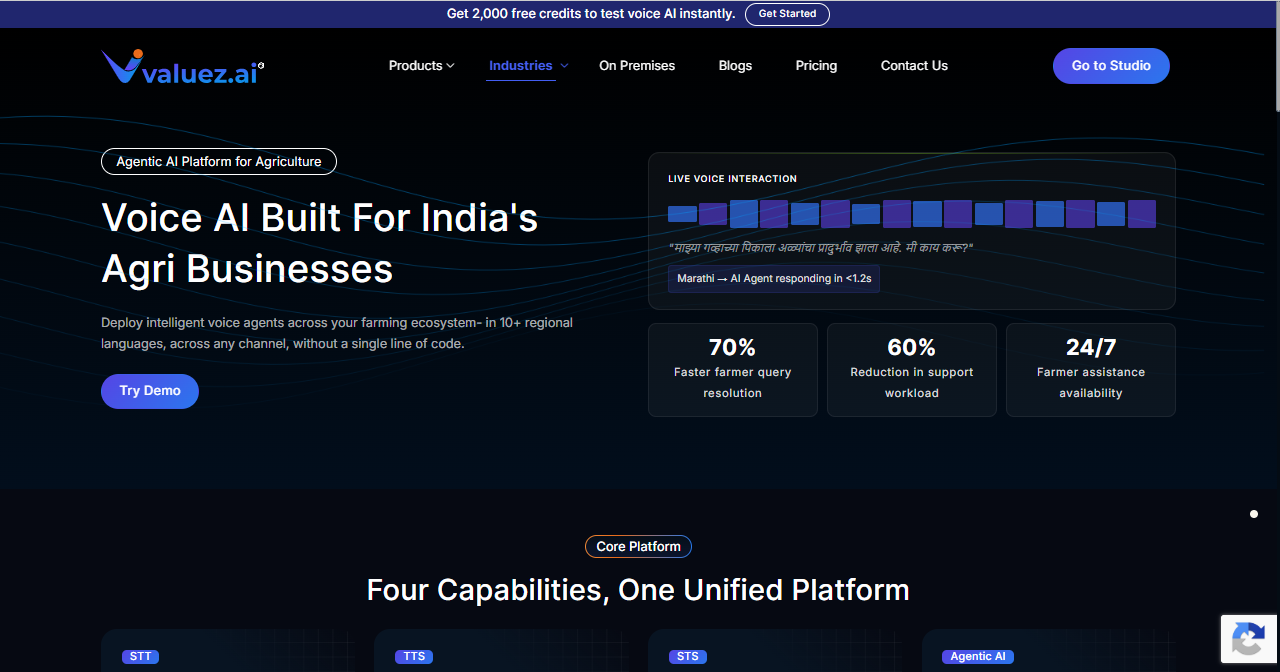
AI handles repetitive queries and reduces human workload. Platforms such as valuez.ai focus on voice automation.
3. Farmer advisory systems
AI systems give suggestions on:
- Crop protection
- Irrigation planning
- Soil management
Example: conversational systems like AgWise integrate agronomy with digital support.
4. Lead and order management
Tracks:
- Input orders
- Dealer transactions
- Supply chain movement
5. Integration with agriculture platforms
Modern systems connect with:
- ERP tools
- eCommerce platforms
- Government agriculture databases
Real-World Use Cases
Agri businesses across the value chain use call center solutions to streamline farmer support, manage dealer networks, handle inquiries, and improve communication across agricultural operations.
1. Fertilizer and pesticide companies
They use call centers to:
- Handle dealer orders
- Provide product guidance
- Track field complaints
2. Seed distribution companies
They manage:
- Seasonal demand spikes
- Farmer onboarding
- Crop-specific recommendations
3. Government agriculture helplines
Large-scale systems like Kisan Call Centers handle millions of queries using structured datasets and AI models.
4. Agri e-commerce platforms
They use call centers to:
- Confirm orders
- Resolve delivery issues
- Provide product support
Technology Behind Modern Agri Call Centers
Modern agri call centers are powered by advanced technologies such as AI, NLP, cloud communication, and data analytics, enabling faster responses, smarter support, and more efficient farmer engagement.
1. Natural Language Processing (NLP)
Used to understand farmer queries in local languages.
2. Machine Learning classification
Groups queries into categories like:
- Crop disease
- Fertilizer advice
- Weather issues
3. LLM-based AI systems
New systems use generative AI for real-time responses.
4. Speech-to-text + voice AI
Allows farmers to speak instead of typing.
Benefits of Call Center Solutions for Agri Businesses
Call center solutions help agri businesses improve communication, enhance farmer support, streamline operations, and make data-driven decisions while managing customer interactions more efficiently.
1. Faster Response Time
AI-powered automation reduces wait times and enables quicker resolution of farmer inquiries.
2. Better Farmer Engagement
Consistent and timely communication helps strengthen farmer relationships and build trust.
3. Lower Operational Costs
Automation reduces reliance on large support teams and improves operational efficiency.
4. Data-Driven Decision Making
Businesses gain valuable insights from customer interactions, crop trends, and demand patterns.
5. Improved Scalability
The system efficiently manages high call volumes during peak agricultural seasons.
Challenges in Agri Call Center Systems
While modern call center technologies have improved agricultural communication, businesses still face challenges related to connectivity, language diversity, data management, and technology adoption in rural areas.
- Poor rural internet connectivity
- Low digital literacy among farmers
- Complex agricultural terminology
- Data fragmentation across systems
- Limited high-quality training datasets
Future of Agri Call Center Solutions (2026 and Beyond)
The future of agri call centers is being shaped by AI, automation, and data-driven technologies that will enable more personalized farmer support, predictive insights, and seamless communication across the agricultural ecosystem.
1. Fully AI-driven agricultural support systems
Voice AI will handle most first-level queries.
2. Hyperlocal advisory models
AI systems will give region-specific farming advice.
3. Predictive agriculture support
Systems will predict:
- Pest attacks
- Weather risks
- Market price trends
4. Unified agri communication platforms
All channels (call, WhatsApp, app) will merge into a single system.
Conclusion
Call center solutions for agri businesses are becoming a critical part of modern agriculture operations. They combine CRM systems, AI voice technology, and agriculture knowledge platforms to improve communication between farmers, distributors, and agri enterprises.
As agriculture becomes more data-driven, these systems will continue evolving toward AI-first, multilingual, and predictive support ecosystems that improve productivity and reduce information gaps.
FAQ
-

Krishna Handge
WOWinfotechJun 06,2026