How MarTech Improves ROI for Businesses (2026 Guide)
_(1).jpg)
MarTech (Marketing Technology) in 2026 uses automation and data analytics to help businesses plan, execute, and optimize marketing in real time. It connects tools like CRM systems and Customer Data Platforms (CDPs) to understand customer behavior and deliver personalized experiences.
By using AI-driven insights, MarTech improves targeting, efficiency, and decision-making, helping businesses increase conversions, reduce costs, and achieve higher ROI.
What is MarTech?
MarTech (short for marketing technology) refers to the tools, software, and platforms businesses use to plan, execute, and track marketing campaigns, manage customer data, and automate workflows. It enables data-driven marketing, improves efficiency, and enhances customer engagement across digital channels, helping businesses increase conversions and ROI.
How MarTech Improves ROI for Businesses
Here is a step-by-step breakdown of how MarTech improves ROI for businesses.
1. Advanced Personalization and Targeting
MarTech uses AI and customer data to understand user behavior and show relevant content, offers, and ads. This increases engagement, improves conversions, and increases customer lifetime value (CLTV), leading to higher ROI.
AI-driven MarTech tools analyze:
- Browsing behavior
- Purchase history
- Engagement patterns
- Customer preferences
- Demographic data
How This Improves ROI
Personalized experiences lead to:
- Higher click-through rates
- Better customer engagement
- Increased conversions
- Higher customer lifetime value (CLTV)
When businesses deliver relevant content at the right time, customers are more likely to buy. That directly increases marketing ROI.
2. Operational Automation and Efficiency
MarTech automates tasks like emails, lead nurturing, and campaign scheduling, saving time and reducing manual work. This lowers costs, improves efficiency, and helps businesses scale faster, leading to higher ROI.
These include:
- Sending emails
- Lead nurturing
- Campaign scheduling
- Social media posting
- Performance reporting
Marketing automation platforms streamline these workflows.
Automation allows businesses to:
- Launch campaigns faster
- Reduce human error
- Save operational costs
- Free teams for strategic work
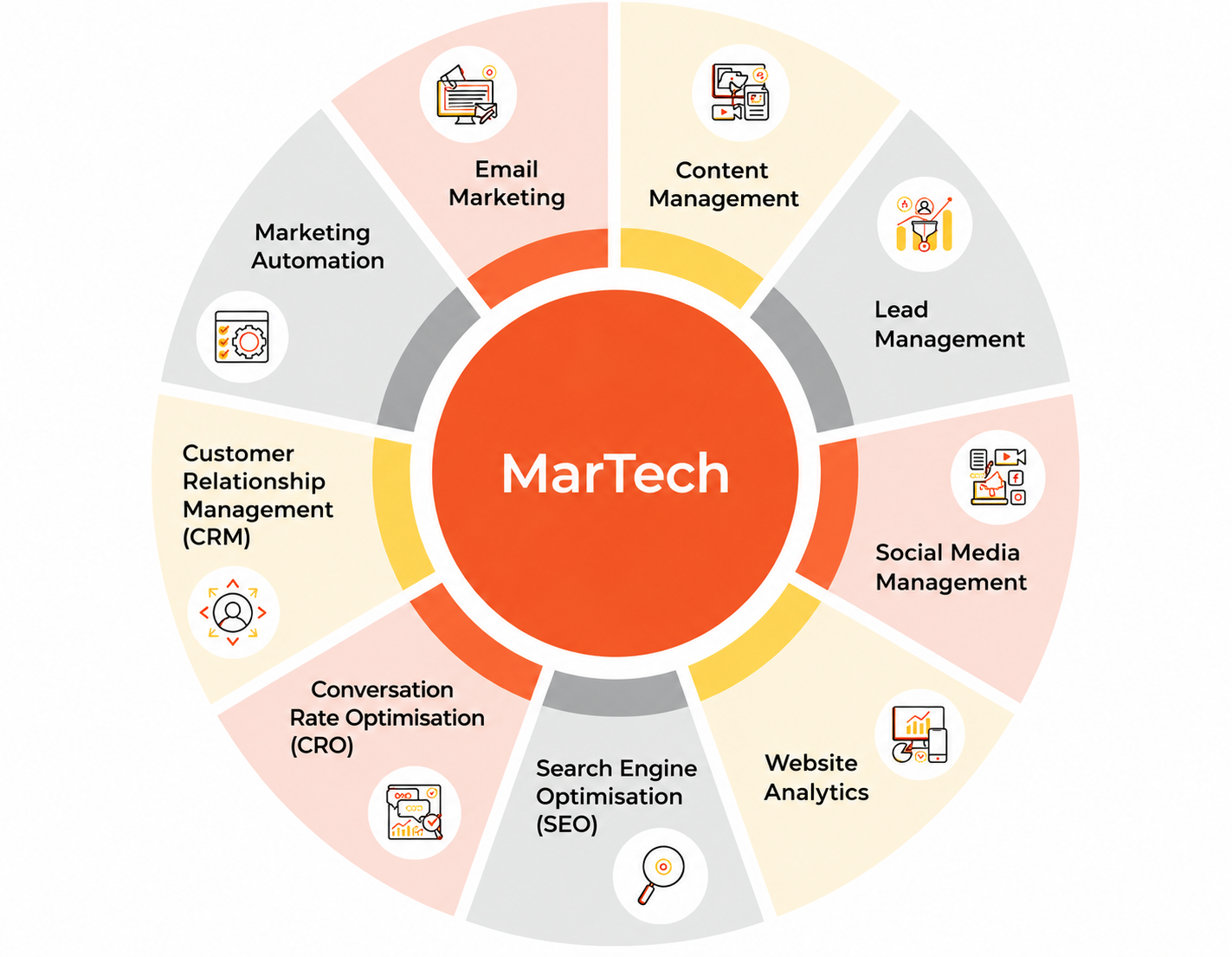
Examples of MarTech Automation
- Email automation
Automatically sends messages based on customer behavior. - Lead scoring
Ranks leads based on engagement and purchase intent. - Campaign triggers
Launches actions when customers complete specific behaviors.
ROI Impact
Operational automation improves ROI by:
- Lowering manual labor costs
- Increasing campaign consistency
- Improving speed-to-market
- Scaling efforts without increasing headcount
This creates significant cost efficiency.
3. Data-Driven Decision Making
Data is the foundation of successful marketing. MarTech platforms collect, organize, and analyze massive volumes of customer data.
This helps businesses make smarter decisions.
Unified customer data from Customer Data Platforms (CDPs) allows teams to track the full customer journey.
This includes:
- First website visit
- Product research
- Email engagement
- Ad interactions
- Final purchase
With this complete view, businesses can identify:
- High-performing channels
- Poor-performing campaigns
- Conversion bottlenecks
- Revenue opportunities
How This Improves ROAS
When marketers know exactly which channels generate revenue, they can optimize spend.
This improves:
- Return on Ad Spend (ROAS)
- Budget allocation
- Conversion efficiency
Instead of guessing, businesses invest based on evidence.
4. Enhanced Customer Experience (CX)
Customer experience has become a major revenue driver. MarTech enables businesses to create seamless, consistent interactions across channels.
This includes:
- Social media
- SMS
- Websites
- Chatbots
- Mobile apps
Automated, timely, and relevant communication improves customer satisfaction.
ROI Benefits of Better Customer Experience
A better customer experience leads to:
- Stronger customer loyalty
- Repeat purchases
- Reduced churn
- Lower customer acquisition costs (CAC)
Acquiring new customers is expensive. Retaining existing customers is far more profitable. MarTech supports retention through smart engagement.
5. Improved Analytical Insights
Modern MarTech provides real-time analytics.
Businesses can instantly track:
- Campaign performance
- Customer engagement
- Conversion rates
- Revenue attribution
- Channel effectiveness
Advanced platforms also use predictive modeling.
This helps forecast:
- Customer purchase intent
- Churn risk
- Future revenue opportunities
Why This Important for ROI
Real-time insights allow teams to:
- Pause underperforming campaigns
- Increase spend on top performers
- Optimize messaging instantly
- Reduce wasted budget
Marketing becomes agile and revenue-focused.
MarTech Stack Tools
CMS: Create and manage digital content (e.g., WordPress, Adobe Experience Manager).
CRM: Manage customer relationships and sales (e.g., Salesforce, Hubspot).
CDP: Unify customer data from all sources
MAP: Automate marketing campaigns and workflows (e.g., Marketo).
AdTech: Manage and optimize digital advertising
MarTech Use Cases for Improving ROI
Here are the most effective MarTech use cases that help businesses improve ROI.
1. Content Generation & Optimization (GenAI)
Businesses use generative AI to create and optimize content for SEO, blogs, ads, and social media. This improves content quality, saves time, and increases traffic and engagement.
2. Marketing Automation
MarTech automates tasks like email campaigns, lead nurturing, and social media posting, improving efficiency and reducing manual work.
3. Predictive Analytics & Data Insights
AI analyzes customer data to predict behaviors like buying intent or churn risk, helping businesses optimize strategies in real time.
4. Customer Relationship Management (CRM)
CRM systems manage customer data and interactions, helping businesses nurture leads and improve sales performance.
Industry-Specific Use Cases
|
Industry |
Use Case |
How It Improves ROI |
|
Retail & E-commerce |
Personalized recommendations, AI chatbots, targeted offers |
Increases conversions, boosts sales, and enhances customer experience |
|
Agriculture (AgriTech) |
Targeted campaigns, seasonal promotions, regional content |
Improves farmer engagement, demand forecasting, and product adoption |
|
B2B (Enterprise) |
Account-Based Marketing (ABM), lead nurturing |
Improves lead quality, shortens sales cycles, and increases deal conversions |
Conclsuion
MarTech platforms in 2026 use automation and unified customer data to deliver personalized, data-driven marketing through a connected ecosystem. Unlike traditional systems, they continuously improve with real-time insights, helping businesses run more targeted, efficient, and high-converting campaigns.
With tools like CRM systems, marketing automation, and AI personalization engines, MarTech enables seamless customer experiences and smarter decision-making. As competition increases, it has become essential for improving ROI, reduce costs, and drive scalable business growth.
Looking to boost your marketing ROI? Partner with WOWinfotech to build a powerful MarTech strategy and drive measurable business results.
Frequently Asked Questions
- Short-term: 3-6 months
- Long-term: 1-3 years
-

Krishna Handge
WOWinfotechMay 06,2026