Top AI Trends in 2026
AI is growing very fast, and 2026 will be a year for advanced AI adoption in both business and daily life. From machines that create art to smart robots that assist humans, AI is moving from experiments to real-world use. These powerful AI trends will change how we work, learn, shop, and stay safe online. Businesses will use AI to grow faster, while everyday users will experience smarter tools at home and work.
The most exciting part is that AI is becoming easier to use and understand, even for beginners and kids. In this blog, we explore the Top AI Trends in 2026, creating curiosity around the technologies shaping our future.
List Of Top AI Trends in 2026
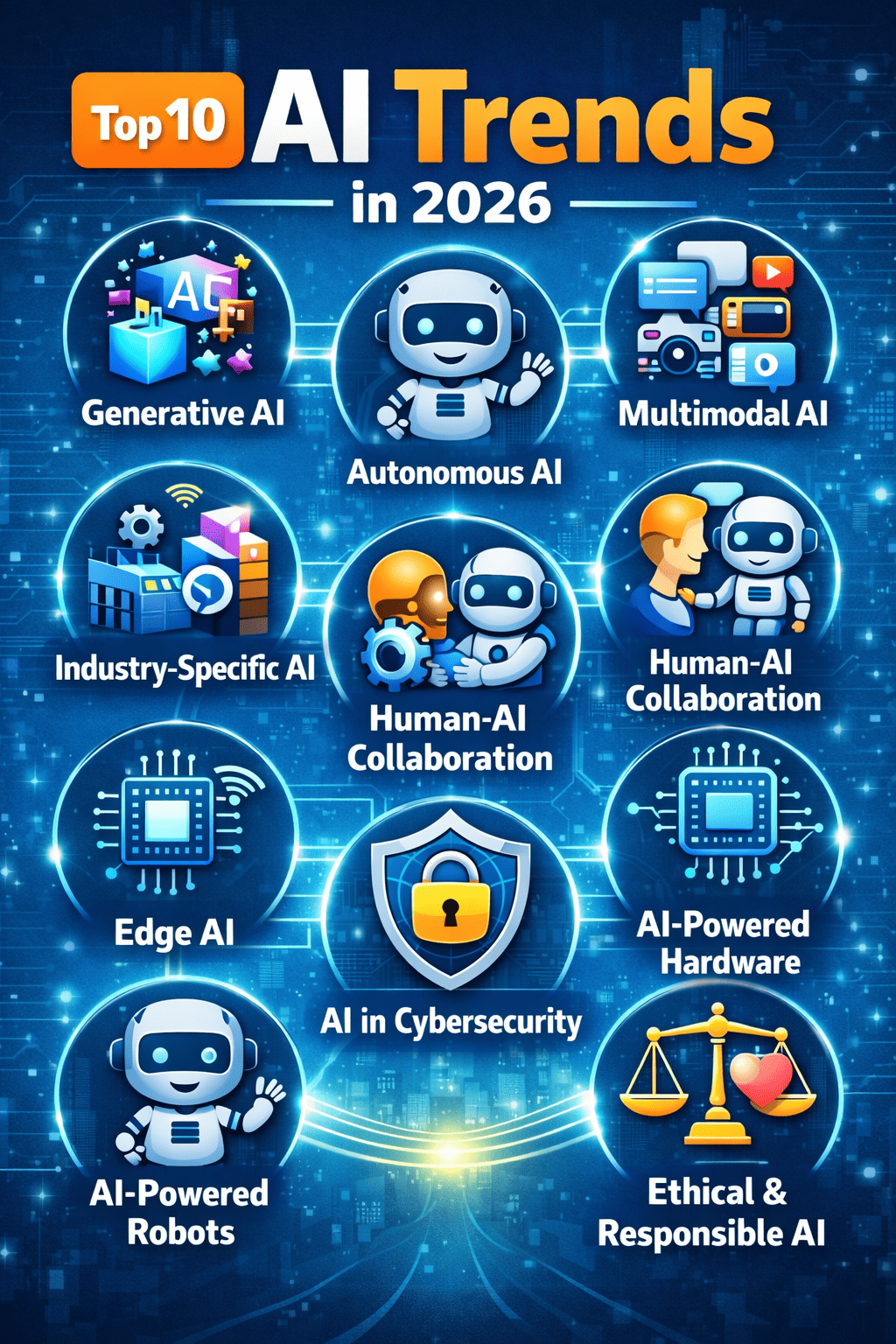
Here are all the AI trends with their uses:
|
No. |
AI Trend |
Main Use |
|
1 |
Generative AI |
Creating text, images, videos, and music |
|
2 |
Autonomous AI |
AI that works on its own |
|
3 |
Multimodal AI |
AI that understands text, images, audio, and video |
|
4 |
Industry-Specific AI |
AI made for specific industries |
|
5 |
Human-AI Collaboration |
Humans and AI working together |
|
6 |
AI-Powered Hardware |
Faster chips and machines for AI |
|
7 |
Edge AI |
AI working directly on devices |
|
8 |
AI in Cybersecurity |
Protecting systems from hackers |
|
9 |
AI-Powered Robots |
Robots helping in daily life |
|
10 |
Ethical & Responsible AI |
Safe, fair, and trusted AI |
1. Generative AI
Generative AI is a type of AI that can create new content instead of just copying old information. It can write stories, draw pictures, make videos, compose music, and even design websites.
Generative AI learns from millions of examples. After learning, it can create something new based on a simple request.
Uses of Generative AI
- Writing blogs, emails, and stories
- Creating images and artwork
- Making videos and animations
- Designing logos and posters
- Helping students to learn faster
Why Generative AI is Important in 2026
In 2026, Generative AI will be:
- Faster
- More accurate
- More creative
2. Autonomous AI
Autonomous AI is a type of artificial intelligence that can make decisions and perform tasks by itself. It does not need a human to guide it every second. Once it is trained and given rules, it can work independently.
Why Autonomous AI Is Important
Autonomous AI helps humans by:
- Saving time
- Reducing human errors
- Increasing efficiency
- Handling repetitive or dangerous tasks
Where Autonomous AI Is Used
|
Area |
Use |
|
Transport |
Self-driving cars |
|
Warehouses |
Robots managing goods |
|
Healthcare |
AI monitoring patients |
|
Customer Support |
AI handling tickets automatically |
3. Multimodal AI
Multimodal AI is a smart type of artificial intelligence that can understand many kinds of information at the same time. It can read text, look at images, listen to voice, watch videos, and study data, all together.
Just like humans use their eyes, ears, and brain to understand the world, Multimodal AI does the same using technology.
Examples of Multimodal AI
- Voice assistants that see images
- Medical AI reading reports and scans
- AI chatbots that understand pictures
Types of Inputs Multimodal AI Can Understand
|
Input Type |
Example |
|
Text |
Emails, messages, documents |
|
Images |
Photos, drawings, medical scans |
|
Audio |
Voice commands, music |
|
Video |
CCTV footage, tutorials |
|
Data |
Numbers, charts, records |
4. Industry-Specific AI
Industry-Specific AI is a type of artificial intelligence that is built and trained for one particular industry or field, instead of trying to do everything.
It learns from industry-related data, rules, and real examples, so it understands that job very well.
Examples by Industry
|
Industry |
AI Use |
|
Healthcare |
Diagnosing diseases |
|
Finance |
Detecting fraud |
|
Retail |
Predicting customer needs |
|
Education |
Personalised learning |
Just as a doctor is trained solely for healthcare and a teacher is trained solely for teaching, Industry-Specific AI is trained using industry-related data, rules, and real-world examples. This makes it more accurate, faster, and more reliable than general AI.
Because it focuses on a single industry, Industry-Specific AI can solve problems more effectively and help businesses operate more efficiently.
5. Human-AI Collaboration
Human-AI Collaboration means people and artificial intelligence working as a team. AI does not replace humans. Instead, it helps humans do their work better, faster, and more easily.
How They Work Together
- Humans give ideas
- AI does fast analysis
- Humans make final decisions
Where Human-AI Collaboration Is Used
1. Workplace
- AI prepares reports
- Humans review and decide
2. Healthcare
- AI suggests diagnoses
- Doctors make final decisions
3. Education
- AI personalises lessons
- Teachers guide students
4. Design & Creativity
- AI generates ideas
- Designers choose and improve them
Source: ChatGPT
6. AI-Powered Hardware
AI-Powered Hardware refers to computer hardware that is specially designed to run artificial intelligence faster and more efficiently.
Instead of using normal computer parts, AI-powered hardware uses special chips and processors that are built to handle heavy AI tasks like learning, predicting, and analysing data.
What Makes Hardware “AI-Powered”?
AI-powered hardware includes:
- Special AI chips (like GPUs, TPUs, NPUs)
- High-speed processors
- Advanced memory systems
- Energy-efficient designs
These parts help AI run faster, cheaper, and with less power.
Examples of AI-Powered Hardware
|
Hardware Type |
What It Does |
|
GPUs |
Process AI data very fast |
|
AI Chips |
Built only for AI tasks |
|
Smart Sensors |
Collect real-time data |
|
Edge Devices |
Run AI directly on devices |
7. Edge AI
Edge AI is a type of artificial intelligence that runs directly on devices, instead of sending data to far-away cloud servers. These devices can be phones, cameras, watches, robots, or smart home gadgets.
Devices That Use Edge AI
|
Device |
How Edge AI Helps |
|
Smartphones |
Face unlock, voice assistant |
|
Smart Cameras |
Motion detection |
|
Smart Watches |
Health tracking |
|
Home Devices |
Voice control |
|
Cars |
Driver assistance |
Benefits of Edge AI
- Low latency (quick response)
- Better data privacy
- Less internet usage
- Reliable performance
- Real-time decision making
8. AI in Cybersecurity
AI in Cybersecurity means using artificial intelligence to protect computers, networks, and data from online threats like hacking, viruses, and scams.
What AI Can Do
- Detect threats early
- Stop cyber attacks
- Monitor systems 24/7
Cyber attacks are becoming more advanced. In 2026, AI will be essential for keeping digital systems safe.
9. AI-Powered Robots
AI-Powered Robots are machines that use artificial intelligence to think, learn, and act. These robots do not just follow instructions; they understand their environment.
Where Robots Are Used
- Hospitals
- Warehouses
- Homes
- Restaurants
In 2026, robots will become more friendly and helpful.
10. Ethical & Responsible AI
Ethical and Responsible AI means using artificial intelligence in a way that is fair, safe, honest, and trustworthy.
Why Ethical AI Is Important
AI makes decisions that affect lives. So it must:
- Treat everyone fairly
- Respect privacy
- Be transparent
AI in Cybersecurity keeps us safe, AI-powered robots help us in real life, and Ethical AI ensures everything is done responsibly.
Conclusion
Artificial Intelligence in 2026 will become a helpful part of everyday life. From smart machines and robots to safer online systems, AI will support humans rather than replace them.
Trends like Autonomous AI, Multimodal AI, and Industry-Specific AI show how technology is becoming smarter and more useful. When humans and AI work together, tasks become easier, faster, and more creative.
Are you looking for AI services? WOWinfotech delivers custom AI development, intelligent automation, and smart solutions that help businesses grow faster, work smarter, and stay competitive in the digital age. Call 9370104077 or 8999918293, or email [email protected].
-

Krishna Handge
WOWinfotechDec 30,2025